
This article is written by Sandra Naranjo Bautista, an Independent Consultant, founder of Better Govs and Former Minister and Acting Vice President of Ecuador. A version of this article was first published by Better Govs.
Paraphrasing Einstein, policy implementation should be made as simple as possible, but not simpler, which is also our motto at Better Govs. In this article, I summarise five actionable tips for effective policy implementation you can start using today. You can download the full guide with examples and practical exercises here.
These five tips have been my travel companion as a Cabinet Minister in Ecuador and as a consultant with several international organisations, and are the result of what I learned during my years at the Harvard Kennedy School and my experience using them in the "real world", beyond the classroom. The five secrets are simple, powerful and backed up by technical knowledge and practical expertise
Secret 1: Define where you are going
The most important step in policy implementation is to be specific in your goals. It might sound obvious, but believe me, it is not.
A clear objective is your reference, your North Star. A well-defined objective should be crystal clear for you and for everyone else involved in the project or policy. Furthermore, there should be a consensus among everyone involved as to what the objective is.
Secret 2: Decide how you are going to get there
The most useful framework I have found to evaluate your policy alternatives is Harvard’s Strategic Triangle. I have adapted it into the Public Policy Pyramid (See below).
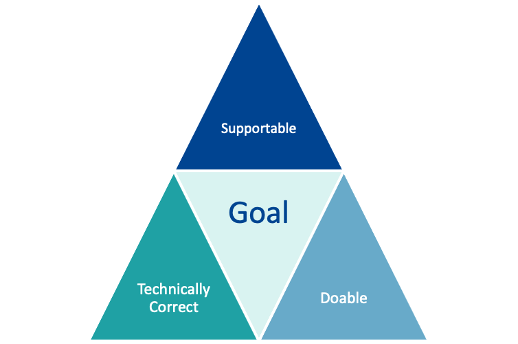
Figure 1: Public Policy Pyramid
Source: Moore, M. (1995). Creating public value: Strategic management in government. Harvard University Press.
The goal—the objective you want to achieve—is at the centre. To achieve that objective, there are three conditions your programme has to meet simultaneously (the triangle). It has to be:
- Technically correct: You need to have a clear understanding of how and why the desired change will happen. This is known as the 'Theory of Change'. It explains how your inputs will translate into outputs and outcomes.
- Doable: In other words, you must have the financial, human and logistical resources and systems required to design, execute, monitor and evaluate the programme successfully
- Supportable: This is where politics come in. Is there the required backing from the authorisers, for example the President, Minister of Finance, frontline service providers and other relevant stakeholders to implement your policy or programme?
Secret 3: Monitor your progress
You need to know if your actions are taking you where you want to go. Monitoring your programme allows you to assess if you are on track or if you need to change course. You don’t need a fancy system to start, but you do need a way to measure your progress.
Policies and programmes need to adjust as circumstances evolve. In public policy, one of the challenges is the lack of time and space to think about adaptation
Without basic monitoring, important programme alerts could be delayed or even missed entirely. You want to proactively analyse what needs to be done and take action. A sign that you haven’t monitored your program well enough is if you do a post-mortem on a failed programme to suddenly realise all the things you could have done differently or better (the full guide expands on ways to measure progress).
Secret 4: Adjust as needed
Make the best decisions you can, with the information you have available. Policies and programmes need to adjust as circumstances evolve. In public policy, one of the challenges is the lack of time and space to think about adaptation. There is also resistance to change and risk aversion (read the full guide that includes an exercise to avoid inertia).
Secret 5: Keep moving towards your destination
The public sector is rewarding and frustrating at the same time. You have good days and bad days. I learned three important lessons from those bad days:
The only way to arrive at your destination is to keep moving.
It is easier when you take it one day at a time. To achieve your goal you need to break down the plan into manageable pieces.
Action over perfection. As German statesman Otto von Bismarck said, "Public policy is the art of the possible, the attainable… The art of the next best." I would rather have something and improve on it over time, instead of having nothing at all.
What next?
Government was my home for over a decade.
I recognise the struggles of working in the public sector and the frustration of not getting things done. But I also know the excitement of changing lives. To see that your actions have a real impact. I know you share that feeling (which is hopefully why you are reading this blog). If this resonates with you, Join Better Govs’ new Facebook Group and be part of a community that believes in the power of an effective public sector, and more importantly, is willing to do something to make it better.
You can download the full guide with examples, practical exercises and a bonus tip here.
👋 You can create a post like this one! Share your thoughts with a community of public servants. Learn more
(Image Credit: Unsplash)
Make sure to share your own thoughts with the author by leaving a comment below

Log in or sign up to continue the conversation