
This article is written by Ed Bernacki, at The Idea Factory, Ontario, Canada.
- The problem: The need for innovative ideas for public solutions is great as the complexity of challenges facing societies globally is multiplying.
- Why it matters: Public servants will face a diversity of challenges during their careers. This requires people to offer bold and creative solutions. At times, they will face resistance, perhaps a hostile reaction. And yet, at other times, they will be welcomed.
- The solution: Develop your personal capacity to manage ideas to create bold solutions. Learn to communicate ideas knowing that some people will see any change as risky, and apply this capacity to innovate where useful to do so.
“I want to be bolder and more creative, but my organisation is so risk-averse. Help!”
The above comes from a frustrated Apolitical reader. As a former public servant and a long-time writer on innovation, I found it indicative of what many people face in large organisations. Assuming your goal is to better solve your challenges, being bolder and more creative is a worthy goal. How can you do this? I offer three perspectives that guided my work.
Perspective 1: Build your skills for managing ideas
All public servants will face many difficult challenges in their careers. Some will be problems. Others will create new initiatives. The skills you need are those to manage ideas. Develop your awareness of these as skill sets, not steps in a process. Create a personal learning plan and invest time to study these issues.
- Harnessing insights. Insight starts with deep understanding. It guides our creativity. There are many ways to study a challenge to prompt deep insight. Design thinking, with its focus on empathy and users, is one. There are others too. Read about anthropology. Learn how people shape insights into societies. (A remarkable book is Treading Lightly: The Hidden Wisdom of the World's Oldest People). I recognised patterns in what I was seeing and turned them into prompts.
- Notice the obvious. Notice patterns. Notice how people behave. It may be different from how they say they behave. Ask questions to explore “why” you are seeing what you see.
- Notice the “arrogance of the existing assumptions”. How can you recognise this? When you ask why things happen in a certain way, the answer is, “Because. That’s the way we do it here.” Which assumptions have we stopped noticing? Notice who maintains the status quo. The Canadian Food Inspection Agency studied its staff to discover that many staff follow organisational rules that did not actually exist. A manager likely said something that others assumed was policy.
- Make the implicit…explicit! What assumptions are implicit in the design of something? Travel gives you examples of everyday life that seem normal to the locals yet bizarre to travellers. So much of what we do is based on assumptions we have long forgotten. Write down the implicit assumptions and then question them. Often the act of writing them down makes them seem nonsensical. When I moved to New Zealand I saw dual-flush toilets for the first time. I realised our Canadian solution to reduce water (reduce the size of the tank from 17 litres to 6 litres) was based on our implicit assumption that each flush has the same volume. It works but the dual flush strategy uses less. No one questioned the assumption.
- Generating new ideas. With a base of insights, challenging yourself with a provocation helps: “Wouldn’t it be great if…” Keep saying it until an idea comes to mind. Sometimes a great idea comes to mind. Other times, you need prompt new thinking. Study what others have done. Two older books, Idea Edge and Thinkertoys, are popular with creativity experts. For technical solutions, study TRIZ for breakthrough ideas.
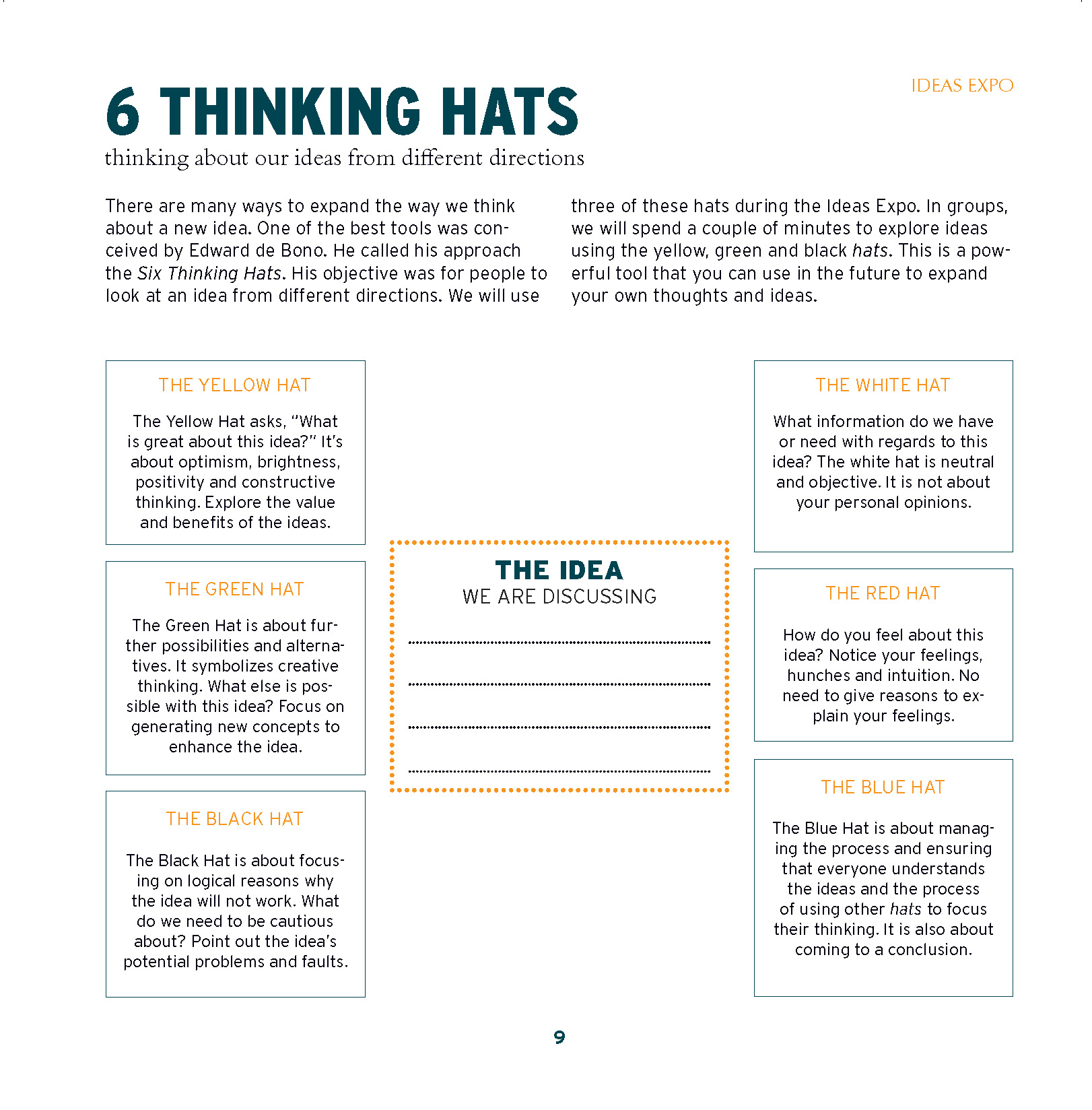
- Judging your ideas. Judging ideas is more than putting sticky paper “dots” on ideas you like. For a Bank of Canada Ideas Expo, I used Edward de Bono’s Six Thinking Hats for a page that teams can use to explore three ideas. They wrote the idea in the middle box and then used the perspective of each hat to expand their thinking. It was very successful and fast.
- Communicating your ideas. A great way to express ideas includes:
- Two ways to explain what your idea is about.
- One way to explain what your idea is not about.
If you see the idea as solving a problem, include your understanding of the problem. Often people reject ideas as they do not understand the problem. You may spend more time expressing the problem than your solutions. Give the listener context. I invented a conference idea journal to solve a problem. The fastest way to explain the problem was to ask; “Have you gone to a conference, taken notes, and never looked at them again?” Most people laugh and say yes. Many saw this as a problem for the first time.
Organisations do not innovate. Staff go to work each day and either use their capacity to innovate or they do not.
You can also apply some basic understanding of cognitive diversity to appreciate how people may hear your idea.
- If you are presenting to a conceptual thinker, start with the big picture, the idea in action. Explain the idea and some challenges that you will face to show your analysis.
- If you are presenting to a detailed, structured person, build a case of insights and facts to show your analysis as a platform to introduce your concept. This gives them the assurance that you did your preparation. They must see how it solves the problem.
Perspective 2: Risk-averse organisations
Stop thinking of organisations as being innovative or non-innovative. Organisations do not innovate. Staff go to work each day and either use their capacity to innovate or they do not. Good managers must create a climate open to new thinking and ensure staff are skilled to solve problems. In every organisation, you will find pockets of innovative thinking.
It is hard for some managers to accept new or different solutions. If there is a secret, it is prompting them to see the value created by a new idea. Communicate your idea to lead to a conclusion that the new idea solves a problem better by creating more value. You want people to see that there is a reward for using a better idea compared to not changing to maintain the status quo. It’s easy to offer tips. I am in a situation now where I will walk away from a public organisation as it is simply too hard to apply any of what I have written above.
Perspective 3: Personal strategies for picking projects or challenges for bold ideas
Gareth Morgan, a Canadian academic, studied management theory for decades. I used his books during my MBA. (I recommend Images of Organisations). He researched an interesting question: what percentage of your work or time do you have complete control over? He asked CEOs, directors and junior staff. All gave similar responses; they control about 15% of their work. He suggests we look at our work from this perspective.
Which projects, assignments, or programmes do you have total control over – the process you use, the timing, and decision-making? Which do you not have total control over? The implication is:
- If you do not control the work, do not frustrate yourself trying to change it. Just do it.
- If you control the work, invest your energy to shape bold ideas. This is your opportunity to be creative without getting frustrated.
In my innovation workshops, I prompt people to see their work as two piles of projects: an 85% pile and a 15% pile.
- For some, recognising their 85% pile is a revelation. It is work they simply must do.
- Seeing their 15% pile is small and open to change, they can invest time to creatively tackle these projects.
This also applies to very big team projects. Morgan saw that teams do not have total control over many elements of big projects. His research found that projects often have the same ratio of elements: 85% you cannot change leaving 15% open for innovative change. Morgan said many projects can be improved by focusing on the 15% that can change.
Bad ideas are still good
I worked with New Zealand Post for my Master’s degree thesis. When I was leaving for the second year of study, I had a bold idea. I remembered our director saying that his door was always open to new ideas. I went to the executive floor. I noticed his door was open and his assistant was away. He was at his desk. I knocked. I reminded him of his open-door policy. He laughed and told me to come in. He gave me five minutes. After five minutes, he told me to continue. We talked for 90 minutes. He liked the idea but felt it would not work based on his knowledge of the technology. He then asked me to write a summary of the concept for his future use.
As I left, he said, “I wish more people came to me with ideas, even bad ones. It means people are thinking and we need people to think…” I returned to the university and then sent him my report. I met him a decade later for lunch. He told me he remembered our conversation and appreciated my initiative.
By then I was a speaker on innovation. This gave me a good story to tell…bad ideas can be good. It is not easy being bold and more creative yet it’s worth finding your 15% opportunities to apply your best work. This is the work you will remember in the future.
👋 You can write an article like this one! Share your thoughts with a community of public servants. Learn more
(Image Credit: Unsplash)
Make sure to share your own thoughts with the author by leaving a comment below

Log in or sign up to continue the conversation