
This article is written by Geoff Mulgan, a professor at University College London who has worked in the past in city, national and transnational government, and Giulio Quaggiotto, an innovation advisor with the MBR Center for Government Innovation in Dubai.
- The problem: Helping policymakers mobilise the knowledge they need to make good decisions is tricky.
- Why it matters: This is hard, especially for complex issues like climate change or industrial policy.
- The solution: Physical spaces that embody the four dimensions that decision-makers need to keep in mind.

During intense crises, governments use control rooms to help them make sense of information and guide decisions. Cross-government teams are set up, decision-making is centralised and there’s usually a physical manifestation of this shift in approach – a room that becomes the centre of things.
💬 Let the author know what you think about centralised decion-making by leaving a comment below
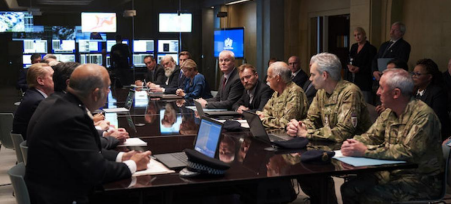
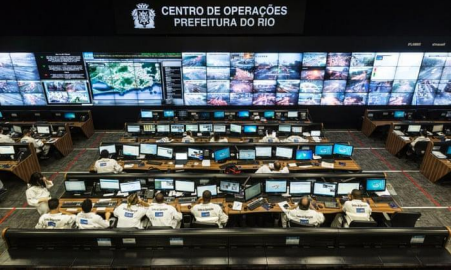
Every government has such a place – like Britain’s COBRA or Rio de Janeiro’s famous control centre (pictured at the end), the latter full of screens pulsating with news on real-time events, alongside data streams, social media feeds and hotlines buzzing with frontline updates. Here, the decision-makers huddle, armed with the crucial inputs they need to navigate complex, fast-moving challenges, from wars to terrorist incidents, pandemics to natural disasters (the picture of COBRA below – with its white, middle-aged men, is a fictional portrayal but not so far from the truth).
Linear prose is often ill-suited to handling complex realities. And performance indicators are often taken out of context and so are easily gamed or become misleading.
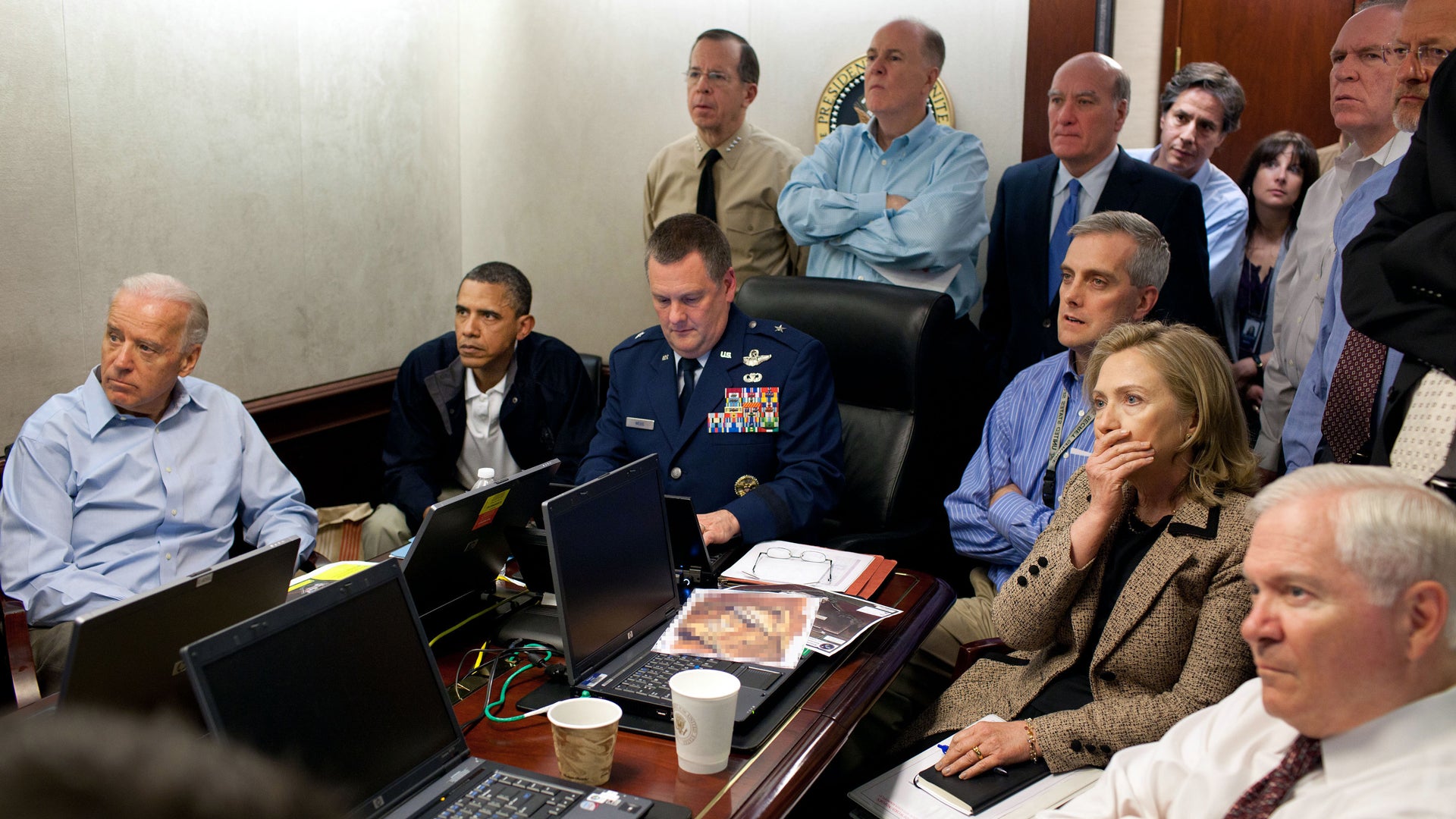
In them, decisions are made which have to synthesise conflicting inputs – fast. As President Obama famously said when authorising the raid on Osama bin Laden’s presumed hiding place: “This is 50–50. A flip of the coin. I can’t base this decision on the notion that we have any greater certainty than that.” Yet the decision drew on lots of different kinds of intelligence and was then observed in real-time, generating one of the most iconic pictures showing the tension of decision-making in a situation room during a crisis.
But what might the equivalent be for slower crises, and the normal work of government? Could physical places be designed that would support better decision-making? We think they can and that they could provide answers to three overlapping issues:
● First, how to bring together the key indicators that governments need to guide decisions;
● Second, how to best visualise these in ways that can be absorbed and discussed; and
● Third, how to use them to feed into decisions that are truly synthetic.
The defaults are familiar. Most of the work of government happens in fairly soulless meeting rooms, with groups seated around a table. Most of it is framed by prose documents setting out proposals, white papers, draft laws and so on. And most use standard reporting systems and scorecards, which provide feedback on performance. These dashboards, potentially a useful tool, are more often than not so sanitised and abstracted from the real-world issues they are meant to represent that they can hinder empathy and an appreciation of nuances (as Shannon Mattern reminded us, the word ‘dashboard’ originally referred to a board on carriages designed to protect them from mud – and yet much of decision-making has to do with getting your hands “dirty” with uncleaned, messy data).
Doing things better
So none of these defaults is really optimal. The meeting spaces are not particularly conducive to creativity or engagement. Linear prose is often ill-suited to handling complex realities. And performance indicators are often taken out of context and so are easily gamed or become misleading. Meanwhile, the rituals of government meetings, with their formal seating arrangements and power dynamics, written and unwritten protocols that determine “who’s in the room” (and who is not) and whose voice matters, are also not designed for effective, collective sensemaking (and ignore much of the science of how to run meetings well).
Many recognise the limitations of existing models which don’t work well for challenges like net zero, poverty or economic growth. This has led to the idea of designing spaces that can help decision-makers think in more rounded ways, providing the key indicators – in the widest sense – within which the performance indicators sit, and providing a prompt for debate and discussion.
We can imagine this as a room – like the control room for crises – but with a different design, shaped more for slower-moving crises, challenges and opportunities. We can take some inspiration from the many parallel types of room used in other fields – like the bridges and quarterdecks in ships; or the cockpit or flight deck in an aircraft.

And perhaps we can also draw some inspiration from the “roads not taken” – like Salvador Allende’s Project Cibersyn’s control room which was originally conceived to provide real-time feedback loops between the “real world” economy and decision-makers.
Four walls for strength
For policymaking, we suggest the room can use its four walls to embody the dimensions that are critical to good decision-making but so often missing or unbalanced:
●THE PATTERNS – The first wall would bring together the patterns: what are the key facts and trends that decision-makers need to be aware of, some about the external environment, some about trends, some capturing performance indicators for government itself.
● THE PROVEN – The second wall would bring together what’s proven (and proven to be problematic): it would gather the hard evidence – interventions with strong support, and also problematic ones that seem promising but don’t work, drawing on the work of ‘What works’ centres, evaluations and evidence maps, systematic reviews and syntheses of all kinds. Such evidence maps can also increasingly make use of large language models trained on reliable research.
●THE PROMISING – The third wall would bring together the promising ideas: innovations of all kinds that might be relevant, whether coming from other countries, other sectors, or emerging on the market.
● THE POSSIBLE – A fourth wall would capture the possible: picturing where might the whole system be in 10-20 years, in other words, what is the broader context for the actions taken now.
All four dimensions are relevant to decisions in the present. An example might be micro-mobility, the spread of rentable and electric bikes and skateboards. The first wall would gather the key trends, the environmental impacts, safety issues, economics and data.
The second would gather what’s known about how these fit into broader urban transport systems. The third might look at new ways of handling integrated payment systems or how to minimise risks. The fourth could picture the prospects of very wide take-up of micro-mobility alongside new public transport, cycling and AV options.
Other topic examples could include: addressing the growth of school absences since the pandemic; coping with disruption to food supplies because of the war in Ukraine; or planning uses of AI in public services.
In practice, these four aspects are the dimensions any good minister or official needs to keep in mind when making decisions. But they are not always brought together and almost never in as vivid a way as a crisis control room. Indeed, a benefit of having such a room is that it would foster a dialogue between teams that in government often operate in isolation: the data, strategy and intelligence people (patterns), the analysts and monitoring and evaluation people (proven), the innovation people (promising) and the foresight (possible) teams.
Such rooms would help to liberate governments from the constraints of tables and offices and the prisons of prose.
The case for such rooms is that good decision-making requires that each of these dimensions is held in the mind simultaneously – before going on to make synthetic judgements. They are justified by what we know from science about how good thinking happens – that it is helped by many kinds of visualisation, by ways to play with and adjust the inputs. And we know that these work even better if you can interact with the facts and options as objects; by walking around as well as sitting down; by interrogating options; and by standing back and seeing the bigger picture.
What’s in a room?
Such rooms would help to liberate governments from the constraints of tables and offices and the prisons of prose. They would combine the digital and analogue representations, showing dynamic patterns and sometimes models that can be adjusted and played with. Machine learning could complement human sensemaking by helping surface hidden patterns. A more immersive version of the room could encourage participants to have a physical experience of the data and patterns that they surfaced so as to explore nuances and contradictions in a more direct way.
Video interviews (e.g. in the case of mobility, with workers whose mobility has been impacted by electric bikes, but also, for example, makerspaces where would-be entrepreneurs hack or 3D print their way to the next-gen mobility product) could help keep decision-makers connected with the reality behind the numbers and the consequences of their decisions.
Indeed, an extension of the 4Ps room could lead to exploring mechanisms to harness the collective intelligence of citizens in real-time, be it as an additional resource or a reality check. Here again, the infrastructure developed for crisis management can provide inspiration: the Indonesian flood response platform Petabencana, for example, was designed as a distributed sensemaking mechanism that helps guide the decisions of disaster response agencies by tapping real-time into the hyperlocal knowledge of citizens. In the UK, the Policy Lab recently experimented with harnessing collective intelligence for fisheries regulation.
Since attention is the scarcest resource in any system, a crucial part of the process of designing such rooms would be to decide which are the most important patterns, proven and problematic options, promising ideas and possibilities. KPIs would be a vital part of their work – but the crucial point is that performance indicators are a subset of the indicators that matter, and their primary focus is accountability (“Did you deliver what you promised?”) rather than sensemaking. So we should think of these as being KIs – key indicators – with KPIs as a subset.
When to deploy, and when not to
Our sense is that such rooms should not be permanent. They should be set up for periods of weeks or months when an issue is live – being given serious attention by decision-makers, whether immediate crises or taking decisions on longer-term questions. But they can have more lasting, pollinating effects. The experience of working in a 4P room should, over time, build teams that are skilled not only in pattern detection and synthesis (described here), but also in working with contradictory and imperfect evidence, surfacing edge innovations and making compelling arguments to help shape decisions. Hopefully, even after rooms are disbanded, the methods and mindsets will continue – one can imagine that even regular day-to-day meetings at different levels across the public sector could benefit from a 4Ps “mindset”. Over time, politicians, too, would be trained to become better synthesisers.
There are complementary methods needed to make the most of them. Many have experimented over many years with different kinds of system maps which can also help to bring together these indicators in dynamic ways – for example, the recent ones developed by IPPO try to map causal patterns, the strength of evidence and who has the power to influence them.
Their value is to feed into synthetic processes, described here, and using them could be a good way to train officials and politicians to become better synthesisers. The key result of the 4P rooms should be new options that are compatible with the indicators – that respond to the facts; fit the evidence; make the most of innovations; and align with broader directions of change. With much of the polycrisis and uncertainty narrative leaving decision-makers with a sense of hopelessness and rushing to quick fixes, the rooms would act as a reminder that they have agency in generating new options if they are willing to embrace new practices.
The next step is to create prototypes and find out what is most helpful, for understanding, negotiation and decision. In time it may be obvious that we need to see, touch and walk around our most important options, rather than only reading about them in numbered paragraphs.
Done reading? Make sure to share your thoughts on policy steering rooms by leaving a comment below ⬇️
(Image credit: Unsplash)

Log in or sign up to continue the conversation