
Francois* was 15 when fighters swarmed his neighbourhood on the outskirts of Bangui, capital of the Central African Republic (CAR), following the outbreak of civil war in 2012. “They killed people indiscriminately,” he said, “I lost my uncle, aunt and several neighbours. My father was a taxi driver, he was killed during one of his trips.” In search of revenge, Francois joined an armed group who provided weapons training in the nearby bush.
Francois declines to talk in detail about his experiences with the militia, but admits he was engaged in “armed operations” in other villages. Now 18, he has disentangled himself from life as a child soldier with support from his mother and vocational training as a carpenter provided by an NGO. His story is common in CAR, where the protracted conflict between government forces and rival ethnic groups led to the recruitment of an estimated 10,000 child soldiers between 2012 and 2015. Despite the country ratifying a UN protocol banning the use of children in conflict in September 2017, violence spiked again in May.
Children have been used in at least 18 conflicts around the world since 2016. These include protracted fighting between the government and a coalition of rebel groups in South Sudan, where all sides have recruited an estimated 19,000 child soldiers, to conflicts in the Middle East and North Africa, where child recruitment rates have doubled over the course of a year.
While child soldiers are not necessarily more numerous than during the African civil wars of the 1990s, they face unprecedented challenges. Warfare today often eschews pitched battles between clearly defined rival forces — conflicts tend to be all-consuming, pitting communities against each other and bringing the frontline to people’s homes. But the UN Special Representative to the Secretary-General for Children in Armed Conflict, Virginia Gamba, revealed new proposals that will be published later this year in an interview with Apolitical. The measures would significantly expand existing protections for children in war zones.
“The international community looks on children affected by armed conflict as if they are a problem that can be solved with demobilisation,” said Gamba. “But it’s not resolved — it’s only the beginning.”
Re-integration of child soldiers into society — let alone projects that prevent children becoming involved in violence in the first place — remains woefully underfunded. But Gamba’s new proposals to extend psychosocial support, safeguard funding for child protection specialists and focus on violence prevention rather than crisis response could save lives and rebuild communities in war-torn states.
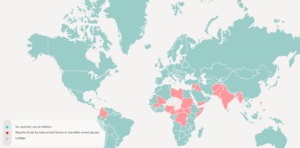 Research by Child Soldiers International mapped where children were being used in conflict in 2018.
An unprecedented challenge
Child Soldiers International, an NGO, published new research in February that maps the use of child soldiers worldwide, and the progress of legislation to tackle the issue. While 167 countries have now ratified the 2000 UN protocol banning the use of children in conflict, at least 85 countries classify the recruitment of children — defined as anyone under 18 — as a criminal offence. Some 27 countries, among them China and Brazil, still have “military schools” which compel children as young as 15 to join the military after graduation. But, according to some researchers, it is a qualitative, not quantitative, change in the phenomenon of child soldiers that is particularly alarming.
“Conflict today is more all-pervasive than we have seen in the past,” said Rachel Taylor, Acting Director of Programmes at Child Soldiers International. “Communities are at the heart of it, it’s no longer armed forces battling it out in particular locations.”
“There is tolerance of child recruitment, not just in Mosul or Kabul or wherever, but also in London, Washington, Paris and Moscow”
The diffuse nature of modern conflict is nowhere more evident than Syria. During that country’s eight-year-long civil war, adjacent neighbourhoods controlled by opposing factions have engaged in prolonged conflict across Damascus, Aleppo and other urban centres. “Conflict is becoming such an endemic part of these children’s lives that it’s extremely difficult to prevent them from becoming involved,” Taylor said.
That shift in the nature of conflict stems in part from the changing tactics of insurgencies. Groups like ISIS and Boko Haram pride themselves on engaging children as combatants. According to Rocco Blume, Head of Policy and Advocacy at Warchild, “whereas before it may have been military necessity, recruiting children has become a first — not last — resort for groups like ISIS.” Using children as fighters has become part of ISIS and Boko Haram’s strategy: not only do they boost their ranks, the shock value of manipulating children has played an important part in the groups’ quest to terrify rivals and observers.
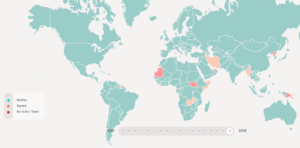 Child Soldiers International mapped the legal status of the UN Optional Protocol, which bans the use of child soldiers, in nations across the world.
Films of children executing prisoners in ISIS-controlled Iraq, or repeated use of children as suicide bombers in Maiduguri state in northeastern Nigeria have shattered taboos even the African civil conflicts of the 1990s avoided.
Manipulating the innocence of children isn’t just about creating a grim spectacle. It has inspired sinister new tactics in insurgencies seeking maximum civilian casualties. The use of child-borne explosive devices quadrupled in Nigeria in 2017, many of them detonated in busy market squares, near universities or at the entrance to camps sheltering those displaced by the conflict.
“Because conflict is much less defined, it’s more challenging than in the 1990s when there was perhaps a clearer end to the fighting and clearer parties involved,” said Taylor. In today’s all-consuming struggles, comprehensive ceasefires — let alone reconciliation and reintegration — remain elusive in many war-torn regions.
The international community: missing in action?
A range of legal documents and UN resolutions are already in place to prevent child recruitment.
The UN’s Optional Protocol to the Convention on the Rights of the Child, adopted in 2000, effectively bans the use of under-18s in conflict. Under the Rome Statute, the treaty that established the International Criminal Court, recruiting under-15s is a war crime that is liable to prosecution at The Hague. And as of 2003, the UN Security Council requires all states listed as perpetrators of a set of offences known as the Six Grave Violations against children — including recruitment of child soldiers — to create a detailed and time-bound action plan to end the problem and rehabilitate those affected.
“Resources are being cut constantly”
As the conflict in Syria has made clear, however, adherence to UN protocol is worth little in the heat of battle. And the ICC has long come under attack for its limited ability to find and convict war criminals. Even where existing measures do influence governments, it is much harder to reach non-state armed groups. “Groups like ISIS and Boko Haram are absolutely impenetrable,” said Blume.
Fresh hope?
At a conference to end violence against children in Stockholm in February, Gamba revealed the expansion of the UN's Children in Armed Conflict Agenda to update guidelines for disarmament, demobilisation and reintegration that could alleviate the plight of children caught up in violence. The agenda is yet to be published, but Apolitical can reveal three key priorities in the UN’s new measures to safeguard children in warzones.
First is an expansion of the basic reintegration services provided by UNICEF from six months to a recommended three years of psychosocial support and income generation training. Demobilised child soldiers often face stigma when returning to their communities, which compounds the trauma they endure while at war. Psychological support, and new means of making a living, are essential to their recovery and reintegration.
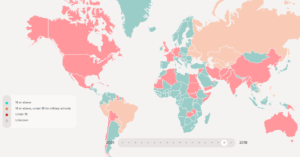 Child Soldiers International mapped the minimum age of recruitment in militaries across the world.
Second, Gamba is calling for the reversal of cuts to child protection advisors who monitor grave violations and broker the safe demobilisation and release of child soldiers. “They are the footsoldiers of demobilisation efforts,” said Gamba, stressing that without them, fewer children would be released from captivity.
“Conflict is becoming an endemic part of these children’s lives"
The third priority is embedding prevention at the heart of the child protection agenda through a greater focus on introducing national laws criminalising recruitment and sexual abuses and economic strengthening to stop children being recruited in the first place.
“Everybody looks at children in armed conflict almost as a necessary evil,” said Gamba. “What we’re saying is that this is a preventable set of violations and we need public awareness, political advocacy and action plans that include prevention in them — whether in international regulations, national law or public information campaigns.”
Challenges ahead
To turn the tide on modern warfare’s attacks on the rights of the child, campaigners and officials claim a sea change is required across the international community.
“Resources are being cut constantly,” said Gamba, particularly for personnel. “Without child protection advisors, you can’t locate children, you can’t negotiate, you can’t demobilise them and you can’t properly evaluate progress against action plans.” Without monitoring and data collection, the prospects and plights of children in armed conflict are effectively unknowable — relegated to the shadows where violations can continue unabated.
But according to Rocco Blume, the financial challenges are merely a symptom of a more systemic failing among the international community.
"It’s not resolved — it’s only the beginning”
“If you look at which countries are recruiting children, many of them are allies of permanent members of the Security Council,” he said. “There is tolerance of child recruitment, not just in Mosul or Kabul or wherever, but also in London, Washington, Paris and Moscow.”
Until political forces recommit to the safeguarding of children in conflict zones, necessary policies are unlikely to reach children like Francois. But Gamba, despite the challenges, remains optimistic.
“We mustn’t give up hope that the situation can be resolved or that they can be rescued,” she said. “We can turn a bad situation into something that not only recovers those children, but also gives them back the right to dream a future.”
*Francois’ story was told to a representative of Plan International, who run reintegration programmes in CAR.
(Picture credit: Albert Gonzalez Farran/UNAMID)
Edward Siddons
edward.siddons@apolitical.co
Make sure to share your own thoughts with the author by leaving a comment below

Log in or sign up to continue the conversation