
Ethiopia is undertaking a bold transformation of its civil service, aiming to build a globally recognised, tech-enabled public sector that delivers inclusive development. In this conversation, Dr. Mekuria, Ethiopia’s Federal Civil Service Commissioner, outlines this vision — how the Homegrown Economic Reform 2.0 agenda builds on its predecessor, how civil servants can become ethical, skilled change agents and how one-stop service models and AI-powered academies are reshaping governance. Along the way, we explore Ethiopia’s natural advantages, the push for citizen-centred service delivery and why strengthening civil service capacity is vital for long-term national progress.
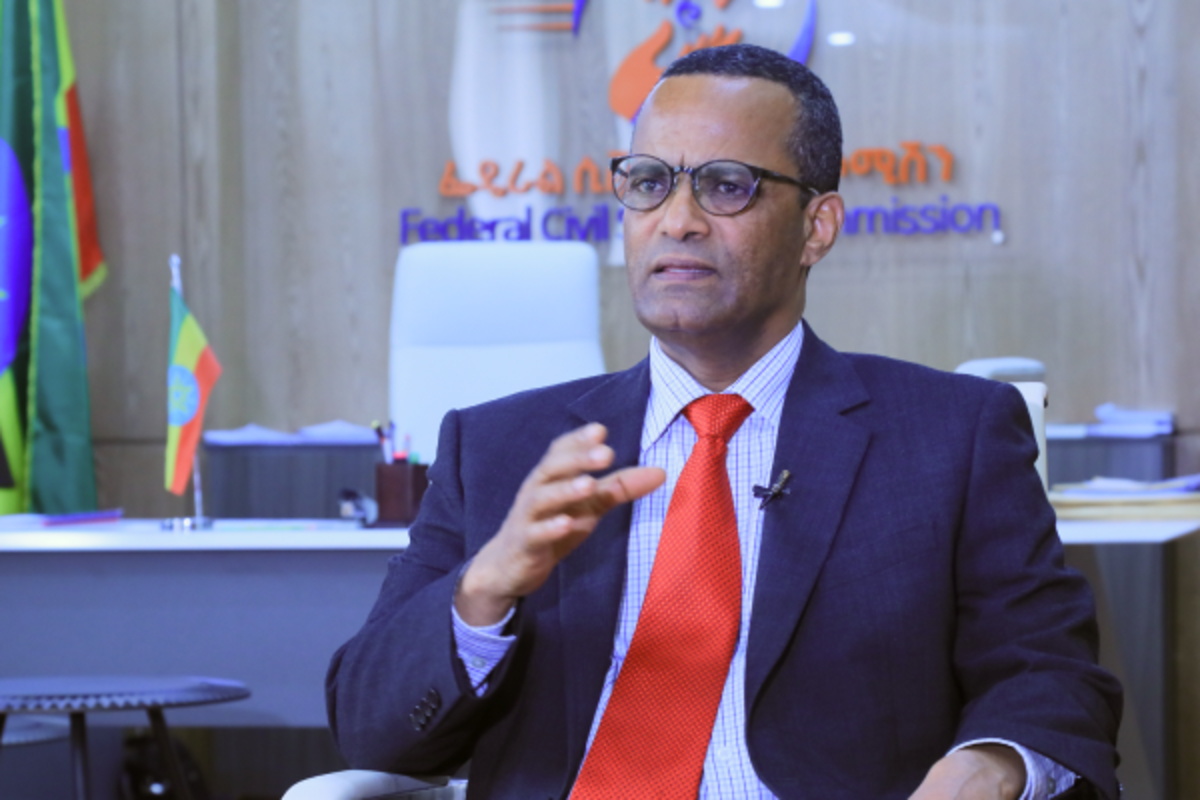
Q: **As the federal civil service commissioner, what is your overall vision for building the capacity and capability of Ethiopia’s public sector? Why do you believe that strengthening the civil service is so critical? **
This is not just my vision — it is our collective vision as an institution, as a commission, and as the entire team of the Civil Service Commission. By 2030, we envision a civil service equipped to fulfil its mission and responsibilities effectively, delivering services that uphold high efficiency standards, which are recognised by our citizens and the African Community.
A central pillar of this vision is the strategic adoption of modern technologies. Why is this important? Ethiopia, as a developing nation, is endowed with abundant natural resources and favourable agricultural conditions, including extensive arable land and plentiful water supplies.
If our civil servants can deliver services effectively and efficiently, they will play a pivotal role in streamlining processes for investors and enhancing procedures related to licensing, taxation, imports and exports. This aligns closely with the government’s broader development agenda, particularly in agriculture, where Ethiopia is still in its early stages.
A wealth of advanced, late-entry technologies can modernise our agricultural sector. Civil servants can support farmers by facilitating access to innovations, boosting productivity and enabling fiscal policies that strengthen the macroeconomic environment, especially in rural areas. In addition to this, the civil service can act as an enabler for private sector growth, foreign direct investment and improvements in the quality of education and healthcare services. Our civil service workforce includes professionals in education, health and agriculture, totalling approximately 2.5 million registered civil servants. This represents a significant reservoir of human capital. If we can enhance our systems through improved technology, stronger human resource competencies, and increased institutional capabilities, we can make meaningful contributions to national productivity enhancement.
That is why we envisage a capable, effective and efficient Ethiopian civil service.
Q: Can you share some initiatives or reforms that have already been implemented to enhance public sector capacity and capability? What are some success stories or improvements you've seen so far that demonstrate how a stronger civil service can make a difference?
The reform is just a recent initiative and may be too early to talk about success. However, let me identify a few indicators of good signs. For example, we received cabinet-level approval for the Public Service and Governance Policy, along with the approval of the Proclamation for Public Service and Governance in parliament, which strengthens the enforcement power of the policy. We have also developed a roadmap comprising seven key pillars:
First, creating a seamless organisational structure while improving occupational classification and pay. Second, managing civil servants' competencies effectively. Third, focusing on service improvement and modernisation. Fourth, fostering an inclusive and diversified civil service. Fifth, establishing a modern human resource management system. Sixth, digitising and digitalising the civil service. Seventh, promoting capable reform leadership to implement these programmes, which we refer to as pragmatic leadership development. This includes enhancing training centres, conducting monitoring and evaluation, engaging in quality assurance activities and recognising civil servants who perform exceptionally well. The roadmap incorporates all these components, as well as the necessary paperwork, such as standards, directives, regulations and manuals, to ensure clear and transparent documentation for implementing this policy framework.
We have already begun piloting the public service and governance reform initiatives across 8 of the 23 ministries in Ethiopia, including the Ministry of Agriculture, Ministry of Education, Ministry of Health, Ministry of Labour and Skills, Ministry of Planning and Development, Ministry of Revenue, Ministry of Finance, and Federal Civil Service Commission. We have divided the implementation of the reform into three waves. Within those three waves, we have further segmented the implementation into three parts: the preparatory stage, the implementation stage and the consolidation or innovation stage. Having just initiated the first wave, those 8 ministries involved are finalising the preparatory stage and are about to enter the implementation phase.
Since launching the reform in the first wave, I can say that we are already seeing signs of service improvements, better working environments and a more enabling atmosphere for staff and citizens seeking the service. These are encouraging indicators of people-centric service delivery.
While accomplishing the preparatory stage is itself a notable milestone, another significant achievement is the establishment of the Modern Ethiopia Services for Organised Benefits (MESOB). This project leverages state-of-the-art technology to consolidate all federal-level services under one roof. It is an impressive initiative which, following the reform, has begun offering 123 services from 23 Institutions to the public. The government is highly satisfied with this outcome and has decided to scale it up to the 14 regional states, which include two cities: Dire Dawa and Addis Ababa. These states have been set a target to complete the one-stop shop by October 2025 for all 14 Regional states and fully inaugurate it before December. Hence, by December 2025, Ethiopia will have 15 MESOB One-Stop Shop Service Centres. This is an ambitious and bold initiative taken by the Ethiopian Government.
Q: Ethiopia is pursuing the Homegrown Economic Reform 2.0 agenda to transform its economy. How does the Economic Reform 2.0 agenda build on the original 1.0 agenda to advance this transformation?
The Homegrown Economic Reform 2.0 agenda is structured around four key pillars or programmes.
The first is macroeconomic balancing of the imbalance, which includes the overall health and stability of the nation’s economy, particularly in terms of its key aggregates, such as output, productivity, employment, inflation, trade, and public finance. At present, there are imbalances between demand and supply, between imports and exports, and challenges in unemployment and inflation. There are also disparities between the demand for and supply of money, as well as goods and services, within Ethiopia. The government aims to address these challenges to establish a healthier balance across the economy.
The second pillar focuses on sector-specific initiatives. The government has identified five multi-polar development initiatives to enhance productivity and strengthen Ethiopia’s competitiveness. These focus areas include, first, unlocking the potential of tourism, secondly, creating an enabling environment for mining, and thirdly, improving the conditions for agriculture. Fourthly, capturing the latecomers' advantage of technology. Fifthly, creating a conducive environment for manufacturing, such as logistics and other infrastructure improvements. Together, they form a multi-polar development framework spanning five priority sectors.
The third pillar is private sector enhancement. Historically, Ethiopia placed considerable emphasis on public enterprises — government-owned institutions such as Ethiopian Airlines, telecom services, and shipping lines, which received the majority of financial support. For example, approximately 70% of bank loans were previously allocated to these public enterprises.
To address this, the government has introduced policies encouraging public enterprises to operate independently, becoming profit-oriented and self-sustaining, rather than dependent on state support. As a result, the share of loans allocated to public enterprises has dropped to around 20–30% and the remaining share is becoming the private sector, which indicates banks have been encouraged to direct more lending towards the private sector. This shift has led to improvements in logistics, greater access to finance, and technological advancements such as the expansion of fibre optics and the rollout of 5G. These developments are helping to make the telecom and technology sectors more competitive and business-friendly.
The fourth and final pillar focuses on the implementation of public service and governance policies. This involves building public service institutional capacity to ensure the public perceives government organisations as capable and effective bodies.
In summary, these four programmes form the foundation of the Homegrown Economic Reform 2.0 agenda, designed to drive sustainable economic transformation across Ethiopia.
Q: Looking ahead five or ten years, what is your optimistic vision for the Ethiopian civil service if current capacity-building efforts succeed? How do you imagine a well-equipped, motivated civil service contributing to a more sustainable, prosperous future?
I envision a civil service built upon those seven pillars mentioned before. For instance, implementing a globally recognised occupational classification for public servants would help ensure that civil servants receive a fair share of the gross national product (GNP) derived from domestic revenue as their remuneration and payment for the efficient and effective service that they deliver. I envision a future in which well-paid civil servants are both ethical, competent, and appreciated by service users and recognised by the global community, with their certified skills accurately reflecting their capabilities and earning a meaningful portion of the Gross National Product (GNP).
I also imagine that over 50 to 80% of services in Ethiopia will be delivered through a one-stop shop model of MESOB, enhancing inclusivity and accessibility for all citizens. Moreover, we must cultivate a critical mass of passionate change agents who are technologically adept and committed to driving innovation.
In essence, I envisage an impartial, independent and competent civil service that will earn visibility and recognition across the African continent and the Global Community.
Q: Many public servants often wonder how their personal development connects to national progress. What message would you give to Ethiopia's civil servants about why investing in their own skills and professional growth is so important?
I believe that individuals have immense capacity for innovation and untapped potential waiting to be unleashed.
Ethiopia is richly endowed with natural assets — a population exceeding 120 million, a vast land area of 1,104,300 square kilometres, abundant water resources and a diverse natural environment. These inherent advantages can be transformed into competitive strengths that enhance the well-being of both the population and the civil service.
If we succeed in this endeavour, we will see increased productivity, improved revenue collection and better compensation for civil servants.
Unlocking these capabilities is therefore essential to making a lasting difference in Ethiopia. From our standpoint, working in partnership with Apolitical, we are committed to establishing a “Public Service and Governance Academy” that draws inspiration from successful models elsewhere. Our aim is for this academy to equip individuals with the skills and attributes necessary to become capable and effective civil servants.
We aim to create a platform that empowers civil servants to engage in continuous learning and self-development, enabling them to fulfil their national mission of building the nation through a patriotic movement, which in turn will benefit them. This is the central message I want to convey. We will work in close collaboration with Apolitical to establish a dynamic “Public Service and Governance Academy”. This institution will integrate artificial intelligence and other advanced technologies to provide comprehensive support for governance and system development, developing capable civil servants who deliver their roles and responsibilities in accordance with its mission.
Make sure to share your own thoughts with the author by leaving a comment below

Log in or sign up to continue the conversation