
An astrophysicist by training and experience, Bruno Sanchez-Andrade Nuño joined the World Bank in January 2015, intending to use the scientific tools he'd developed for studying the sun to solve problems closer to home. Since becoming the first data scientist ever hired by the Bank, he has been deploying cutting edge technology all over the Earth.
In Kosovo, drone-photography has quickly created high-resolution maps that document the land rights of the dispossessed, particularly women widowed by the war. In the Philippines, real time traffic data are now adjusting stop lights. In an Asian country that can't yet be named, a Bank development loan can be delivered in step with progress monitored by Big Data. In this last case, which is in line with the UN's Sustainable Development Goals, the loan is to pave roads or upgrade them to motorways; travel time analysis allows the Bank to measure how long it would take each neighbourhood or region to reach hospitals or schools, and then improve the roads that would yield the biggest benefits.
But he is not without misgivings about Big Data's darker sides. Nor has he found the switch into the public service to be an easy one. After working for NASA, Sanchez worked at Silicon Valley start-up Mapbox and he told Apolitical he misses the lightning-fast adaptability of that world. However, he finds that the Bank is modernising not only its tools but also itself, not least by bringing in a new diversity of talent.
What is a rocket scientist doing in the World Bank?
My work at the Bank is as a data scientist, the first one the Bank's hired, which I find incredible. It's to help my colleagues find the operational value of Big Data. That ranges from social media, sentiment analysis, drones, 3D printing; all these kinds of things.
That's quite a remit.
It's a lot. And I have to say it's very fun, but we're a small team, four or five of us, and we have to be very selective. But that huge envelope gives me a lot of space, so satellites, machine learning and drones are the ones I want to focus on. 3D printing I put in the background, because I don't see that much relevance for now.
How do all these innovations connect to the real world?
There's a recent example: the cadastre we made in Kosovo, the map of who owns each parcel of land. It's crucial. In the war, all the men and boys in this particular village, Krusha, were killed and the women were left with no land rights and nothing to do for work. They started planting peppers and formed a cooperative and made their own living. After the first wave of aid starts to go away, they want to apply for loans but they can't because they don't have land rights. By doing very quick drone mapping – a whole valley in just a week instead of the year it takes to make the cadastre map of a country with planes – we can enable them to invest in themselves.
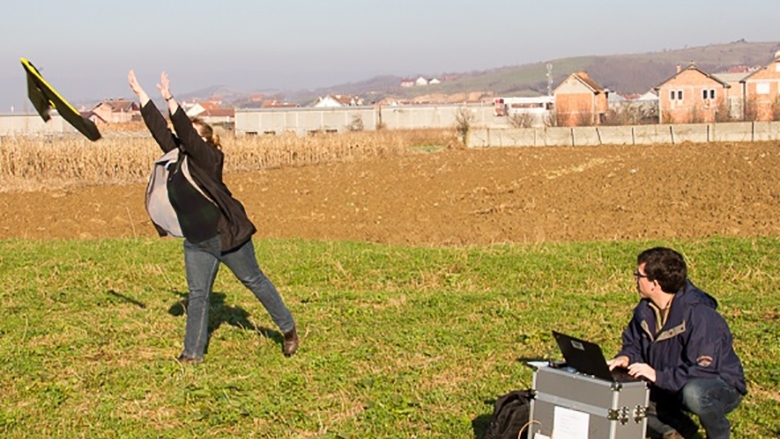 ](https://images.ctfassets.net/txbhe1wabmyx/BMgG5mbKnHNwvLda8zxQR/1576b680beae553d70b259e4cd548466/kathrine-and-bruno-mapping-team.jpg)Sanchez and a colleague launch the drone in Kosovo
So it works?
That's the point. It's not testing, it's not figuring out. The point is not: can we fly drones? Yes, we know we can fly drones. The point is: can we find real value for these innovations? And we've proved that we can do that.
All this information is available because these new tools offer a very fast, effective way of making maps. It's not a huge procurement process, like getting a plane to come from somewhere.
What else can these kinds of tool do?
Our project on mapping roads and deciding which ones to upgrade, for example. We have the data to know what percentage of the world has access to a road, or how far are they in hours from the nearest hospital. If the Bank gives a loan or a grant for this upgrade work, we want to know how it's making an impact, and this gives us the exact metric. Before the start of the process, this is the situation; then we pave this road and this is the situation. And then we give you the next phase of funding. It enables a monitoring system that is completely transparent for how it's helping the population.
So Big Data as a tool for policymakers, rather than just a solution in itself?
Yes. There's another project called Nightlights that's about to be launched, where we took satellite images of 600,000 villages in India and we asked, 'How much light was there in this village every night for 20 years?' Now we have a tool to say, 'How electrified is India, how have government programs impacted that?' It's a huge amount of data, terabytes, but we can put it in a format that is useful for policymakers.
Of course it has limitations – the resolution or if it's cloudy – but it gives a much finer, more real understanding of the effectiveness of electrification programmes.
So is one of Big Data's main promises to refine government's understanding of the situations it's trying to change?
Yes, but it's a tricky space, because of privacy. For example, we went to South Korea, where they can know how many people are in each part of the city by using the cellphone signal. This is great for disasters or for planning public transport. They optimised the night transport system by using the locations at the time where the normal buses close, and where the people live. That is great. It's fantastic.
But it's very close to privacy concerns. We anonymise as much as possible and don't release information to the government side until there are enough people that the anonymisation is guaranteed, because it's a cluster, not an identifiable person. But you need to be careful. We're talking about very powerful systems. That's something I struggle with a lot. I don't want to let data drive technology or let technology drive itself. We need to drive by purpose, not by what we can do. Because maybe what we can do is not what we should be doing. We could know who you are and what kind of services you use, and optimise them, but even though it's possible, maybe it'll infringe your rights.
What do you think is the future for Big Data in government?
A lot. Of course data is not a solution to everything, but it can make a transformational difference. It has done that in Silicon Valley; it has done that in the private sector in general, and it can do that in government. I think it's happening, but only where politicians and policymakers are interested in those solutions.
How do you find working in the public sector?
Very frustrating. Very frustrating.
Why?
Coming from the start-up world to the World Bank, the processes feel very slow. But I need to understand that that is by design. Because a start-up can fail, and that's OK, but you can't do that with the government. There have to be systems in place to balance these waves of innovation from people like me. So while I say it's frustrating, I truly believe in it and I deal with it because it's part of the process.
How could the process be improved?
By incorporating more people with subject matter expertise. Bringing in people from different backgrounds than has traditionally been the case, who are able to understand the nuances and the risks and the opportunities of what you're doing. And I think that's happening in the Bank, especially in the case of climate and the environment.
But I still think the traditional image of a government based on economists and lawyers needs to be expanded with people that represent more the kind of skills you need to do public policy in the 21st century.
So that you can see opportunities?
So that you can have more strategic leadership. Of course you can hire consultants to do the work, but if we do it internally, the awareness, the knowledge that we have institutionally, is kept. Otherwise, it's like Alzheimer's disease, where the knowledge is kept by people who are leaving.
But you see that changing at the moment?
It is changing. I never thought an astrophysicist would have a space in the World Bank. I see people coming from NGOs, the private sector, who thought they would never have a space here. But I do have problems sometimes finding technical people to join my team, because they think, 'Oh, does the Bank do that kind of work?'
How do you persuade them?
There's a limit. Especially in technology, the Bank cannot compete in salaries or in being fast. It's more about: do you believe in what we're doing? And if you believe in that, then come work with us.
And that's what my motivation stems from: to try and bring science closer to all aspects of society. The kinds of thing I was doing when I was studying the sun, pure research, plasma dynamics, those mathematical tools I developed are exactly the same tools I'm using on Nightlights, for example. Exactly the same. Those skills are highly transferable.
And what have you learned about how to get things done more quickly?
To make innovation, I think three things need to happen: small teams; protected teams, meaning we're a little bit independent; and trusted teams, to give us space to test and to 'play', in the sense of innovate and try things out. A playground where you can engage in innovation safely.
How do you build that trust?
We have to be strategic. If you think there's a project that's going to be a huge success but it takes four years and costs a million dollars, it's not a good idea to make that the first one. But if you have a project that can have real impact quickly – or incrementally – that's the kind of work we want to do first.
We also identify the people who are already doing innovative work and highlight them. We put them up front. We don't need to be the ones doing all the work; we just want the process to go forward. And identifying those people and helping them is a core part of our work [in the innovation lab], a strategic decision on how to spend our time.
What skills are you learning at the Bank?
Oh, I'm learning a lot, having the exposure to experts in so many fields. I'm always learning and trying to see where I could help. I had no idea about transportation and when I learned about it, I said, 'Oh, I think I know how to do this.' And they said, 'Really?' And then we started talking about the mathematics of it. I'm learning so much, it's been an incredible experience.
(Picture Credit: Nightlights.io)
Make sure to share your own thoughts with the author by leaving a comment below

Log in or sign up to continue the conversation