
On the sixth of February, Berlin passed a waypoint. It was the first time since the fall of the Berlin Wall, which split the city between the capitalist west and the communist east, that it had been down for more days than it stood.
In Belfast, Northern Ireland, the walls that split the city into a patchwork remain standing. The oldest of these, the Cupar Way "Peace Wall", has stood for 48 years, and is double the height of the Berlin Wall. In total, there are 100 walls in the city, running over 21 kilometres.
Initially set up as a security measure to protect antagonistic Protestant/unionist/loyalist (PUL) and Catholic/nationalist/Republican (CNR) communities from each other, they continue to mark and divide the communities despite nearly 20 years of peace. Conflict has receded from the city following the Good Friday Agreement signed in 1998 between the warring factions in Northern Ireland, but the legacies and mistrust from the conflict remain.
“We’ve had walls constructed in Belfast from 1969 onward,” said Jennifer Hawthorne, Head of Communities for the Northern Ireland Housing Executive (NIHE). “It was always at the site of very severe community conflict: they’re like the physical manifestation of that community unrest and trouble.”
Tension between religious communities remains highest at these walls, which mark the front lines of community violence, and continue to tarnish the lives of the residents who live in their shadows.
“It is a different Northern Ireland, but often it's those communities at these locations that are almost always the most deprived; the most socially excluded,” said Hawthorne. “Those communities do not feel that peace dividend, that sense of security that the rest of Northern Ireland has 20 years on from the Good Friday Agreement. These are communities that still wrestle with all those issues, and perhaps are furthest away from a changing Northern Ireland.”
Forty-two percent of residents in these communities have no contact with their counterparts across the wall, and 87% of these areas are in the most deprived quintile of the whole population.
In the years since the Good Friday Agreement, suicide has reached epidemic levels in the country: over 1998-2014 the rate has doubled (to 3,706), and there have now been more deaths from suicide than there were from the violence in the Troubles. Residents in the communities which sit immediately adjacent to the peace walls are far more likely to suffer from mental health problems than those elsewhere.
Now the city is working to knit the divides which the walls represent. In 2016, the peace wall on the Crumlin Road in the Ardoyne area of Belfast, one of the areas most notorious for sectarian violence, was the first to be successfully removed. In 2017, a defensive wall guarding a police station on Springfield Road was remodelled. In the first instance, the decision was made by the residents themselves.
“The Crumlin Road wall, the first one we took down, took almost three years of community dialogue,” said Hawthorne. “It was the community representatives themselves who had started the dialogue, and then they came to us. We would not have thought that it was a place where residents were ready to move because of what were ongoing issues in North Belfast.”
Solving community problems in Belfast is not as simple as bringing down walls. In many places, people are resistant to their removal. Part of the reason they were erected in the first place was to increase security, and many residents fear for their safety without them. An International Fund for Ireland (IFI) survey of six communities closest to the peace walls found that, on average, 49% of PUL residents believed retention of the walls would have a positive impact on community safety, and 46% of CNR residents believed the same. Over a quarter of all residents wanted the barriers to be maintained at present.
“The only people who can say that it’s safe and welcome are those people that live immediately adjacent to it”
Because of this, the Housing Executive, which manages 21 of the walls and has led the way on the removals and renovations which have so far taken place, insists that communities lead the way on any changes.
“The only people who can say that it’s safe and welcome are those people that live immediately adjacent to it,” said Hawthorne. “It’s a very bespoke and nuanced piece of work that has to be done with them in the driving seat.”
Before any changes can be made to the walls, both communities have to agree on an approach. The International Fund for Ireland, an independent body funded by the EU and the UN, helps to lead these discussions with the housing executive. This is often necessary because both PUL and CNR communities can be suspicious and uncooperative with initiatives led by the Stormont (the Northern Ireland Executive) government.
To help residents reach agreement, architects are involved from the beginning of the consultations. They are tasked with helping people who have lived in the shadow of the walls their entire lives imagine what change might look like. They use 3D models to show the plans as they take shape, which in turn help to shape discussions.
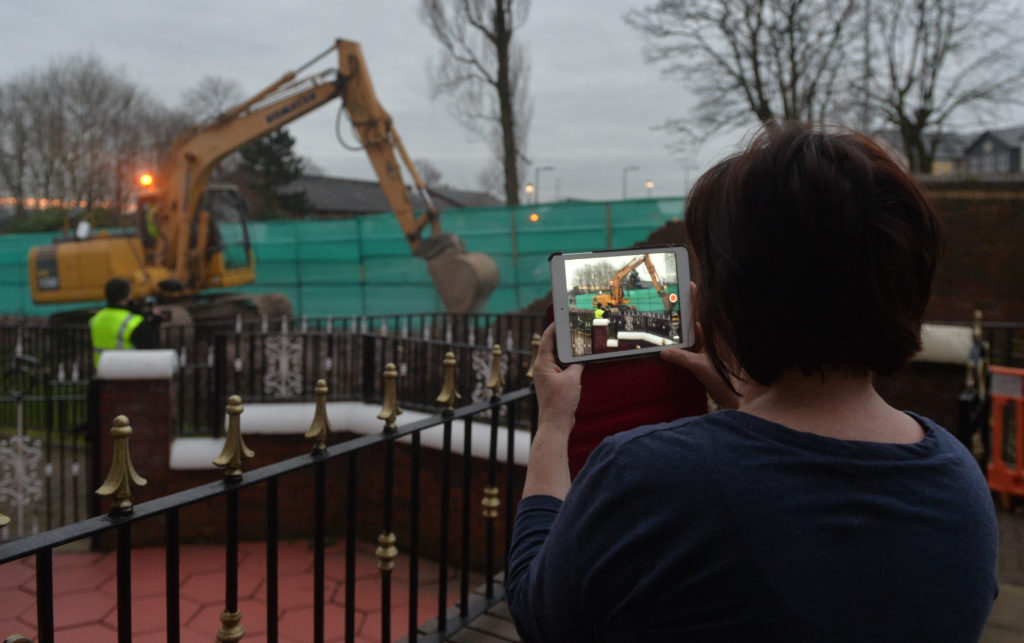 Northern Ireland Housing Executive contractors move in to demolish the peace wall at the Top of the Crumlin Road opposite Holy Cross Church
“What we found was it was changing the conversation from the removal of a barrier - and that they were losing a sense of security - and translating that conversation into, ‘How can we look at regenerating this area, how can we make this area better for those residents?’” said Hawthorne.
On Springfield Road, the wall has been remodelled, with gates added to allow access between both sides of the divide. The wall and its surroundings have been redecorated by children from the community.
The response to the two walls which have been removed so far has been positive.
“I have to say that there is definitely a feel-good factor,” said Hawthorne. “And they were so proud: taking the peace walls down is for the betterment of a deeply segregated Northern Ireland, but it’s not fair that they should carry the burden of societal transformation and conflict transformation. They need to be at the forefront, but they need to have the support that this is something for their betterment.”
In 2013, the Northern Ireland executive government at Stormont pledged to remove all of the remaining peace walls by 2023. Hawthorne welcomes the political commitment for the budget and the timeline. "It’s nice to have a destination point,” she said. “It’s certainly galvanised all the different government agencies to come together.”
Some question whether the commitment is too ambitious. A recent Freedom of Information request revealed that the government’s definition may leave many walls standing in 2023 - and since so many residents believe the walls are integral to their security, they may remain reluctant.
Hawthorne points out that the most important work isn’t the removal of the walls themselves, but the community dialogue - getting people to look across communal boundaries and work together. No wall would be brought down without community consent. In Germany, society is still marked by division between east and west. Overcoming it is about more than removing walls. Despite this, what cannot be doubted is that the successful removals have widened residents’ perspectives.
“It’s the simple things,” said Hawthorne. “The thing that really changed for the residents whose wall was taken down was that they were able to see across the road into the stunningly beautiful Holy Cross Church, and they were able to see the weddings."
“You know, it’s that quality of life of just being open, feeling that you’re not just part of this tiny community behind a wall."
(Picture credit: Colm Lenaghan/Pacemaker Press)
Anoush Darabi
anoush.darabi@apolitical.co
Make sure to share your own thoughts with the author by leaving a comment below

Log in or sign up to continue the conversation