
14 February 2024 | The 8th edition of The Apolitical View by Apolitical CEO and Co-Founder Robyn Scott. Subcribe to the newsletter
In this week's edition:
- Emerging economy governments are tech bulls
- Reverse innovation meets human resources
- Australia’s Public Service battle of the bands
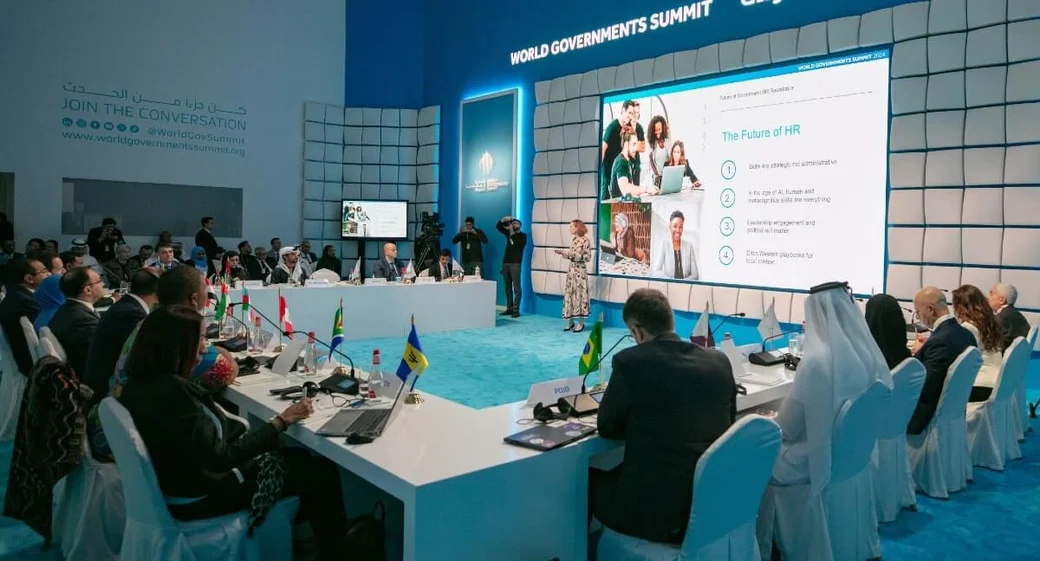
I’m on my way back to London from the World Governments Summit, hosted annually by the UAE Government in Dubai. The Summit is a striking experience for a few reasons. It’s large and glitzy, as are so many things in Dubai. It also attracts a host of powerful people, with heads of state from India, Turkey, Kenya and too many others to count. But what makes it most distinctive is where these powerful people come from and how they see the world.
Some prominent Western figures featured this year, but the centre of gravity in Dubai was emerging markets and their leaders. And while there were a few gloomy conversations — listening to a series of heads of state from small island nations talking about climate change was harrowing — the conversation was distinctly more optimistic than at conferences dominated by high-income countries. As one surprised senior member of parliament from a wealthy country put it to me: “Here government leaders sound empowered”.
And nowhere was there more optimistic, empowered talk than around technology, and specifically artificial intelligence. The UAE has gone so far as to create a “Minister of State for Artificial Intelligence, Digital Economy and Remote Work Applications.” One UAE public servant, who used to be a minister in another country, told me that it was not until they moved to Dubai that they became convinced that AI was a very big deal.
AI was spoken of glowingly as a tool to manage the biggest risks and seize the opportunities of emerging markets. Large youth demographic? AI will provide inexpensive personalised education. Poor health systems and few trained doctors? AI will put top-quality medical advice at the fingertips of health workers. A live video interview with Sam Altman, CEO of OpenAI, was a centrepiece of the conference. Talk of the risks of AI was comparatively absent.
Emblematically, many of these conversations are taking place against the backdrop of the satellites that the UAE has launched as part of its own ambitious space programme.
Peer-to-peer learning abounded at the Summit, but it didn’t take the traditional form of Western countries dispensing aid and advice. Emerging economies were looking to each other. I was struck, speaking at a ministerial roundtable on the future of skills and HR in government, by how many ministers from emerging countries thanked the UAE government for its technical assistance.
And rich countries are looking afar for lessons too. Last week, I was in a meeting with departmental officials in a mature public service. They are grappling with squeezed budgets that are impacting staffing. Could Apolitical, they asked, share examples of emerging markets that had innovated their way around similar resource constraints? Reverse innovation in the context of tech is well established. Rich countries have adopted many of the mobile-first innovations in lower-income countries, for example.
But this was the first time I’d heard of an appetite for reverse innovation in the form of human resources. It will not, I suspect, be the last.
Generative AI and cost-cutting pressures mean human resources and skills have come rocketing back onto governments’ agenda. As the battle to hire, retain and develop a skilled workforce heats up, governments everywhere are shaking up old ways of thinking and looking for new solutions in places they would not formerly think to look. This is a good thing.
I had a lot of fun being interviewed by former UK and Canadian public servant Olivia Neal on the Microsoft Public Sector Future podcast about our new report on “Transforming Public Services Through Generative AI”. Have a listen for pointers for public servants wanting to get started on their generative AI journey.
Robyn Scott
Apolitical CEO & Co-Founder
My recommendations
The Apolitical team has been browsing the recently launched PublicSector TechWatch from the European Commission. With 1000+ use cases of emerging technologies in the EU public sector, from AI to blockchain, it’s exciting to see new applications emerging. I’ve said before that procurement is not the sexiest topic in government, but this example of how AI is helping to standardise tender contracts shows how new technologies can deliver a better experience with governments.
As part of the Government AI Campus, Apolitical is hosting an event next week on Balancing AI innovation with ethics in government. It’ll focus on creating forward-thinking yet responsible policy in the age of AI and features some seriously impressive AI leaders.
And finally...
If you haven’t read about the very first Australian Public Service battle of the bands, I’m delighted to be the one who tells you about it! Canberra’s public servants proved they can trade policy papers for electric guitars in the inaugural competition. Highlights included a rendition of the Ramones punk anthem I Wanna Be Sedated changed to I Wanna Be Seconded, and IT specialists covering Cyndi Lauper’s Girls, They Wanna Write Code. So popular was the event that one of the organisers Leanne Thompson said: “It was like a Taylor Swift ticketing experience. We even got a ticket scammer.”
Got thoughts, feedback or ideas for what you'd like to see in this newsletter? Send them directly to me or leave a comment below.
Make sure to share your own thoughts with the author by leaving a comment below

Log in or sign up to continue the conversation