
1 March 2024 | The 10th edition of The Apolitical View by Apolitical CEO and Co-Founder Robyn Scott. Subcribe to the newsletter
In this week's edition:
- Government investment in R&D is back in vogue
- How AI is changing the questions we ask
- The Uncivil Servants stand-up comedy
Headline-grabbing investments into innovation by governments are coming thick and fast. Ambition is definitely in the air. Building a low-carbon aeroplane is an innovation priority for the French government. To speed up progress on making the plane a reality, France has earmarked €1.2 billion in research and development (R&D), part of a wider R&D budget of €54 billion until 2030. Back in October, the secretary-general of Thailand’s Board of Investment announced tax breaks for carmakers setting up R&D centres, all as part of an effort to become a regional leader in the EV space. In February alone, the UK government announced £125m for AI innovation and regulatory upskilling and £100m for biotech projects, while the White House set out a plan to spend $11 billion on semiconductor-related research.
These commitments reflect a recent trend of growing government investments in R&D. In the EU, for example, member states’ budgets for R&D shot up almost 50% between 2012 and 2022. Some countries made extraordinary leaps: Lithuania’s spending rose by 83.4%, Germany’s by 78.9% and Estonia 78.5%. The US government has already raised its investment by 13.9% since 2020 (from $169.9 billion to $193.5 billion), with more projected for 2024’s budget.
The prize is a big one. Wise government R&D investment can shore up competitiveness, drive economic growth and help solve some of humanity's most pressing challenges. As a reminder of the diverse value of government R&D spending, this has driven: Canada’s significant advances in quantum computing; international collaborations that resulted in CRISPR-Cas9 technology gene editing technology; German development of the MP3 audio format; and the Nobel Prize-winning development of graphene (stronger than steel and more conductive than copper) in the UK. For a deep dive, Mariana Mazzucato’s work has famously raised awareness of the value of government investment in innovation.
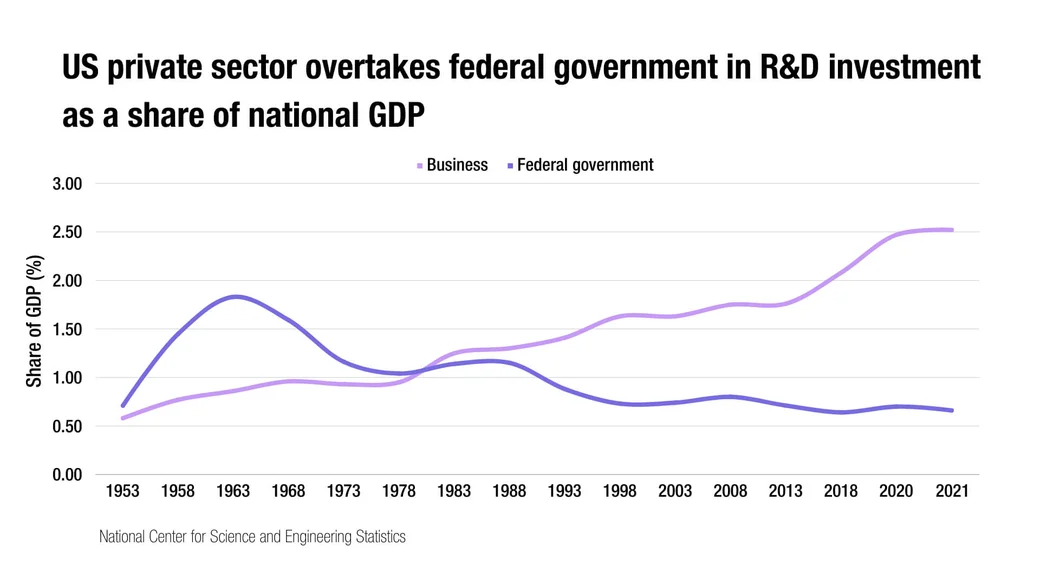
This may signal the beginning of the end of a 70-year trend exemplified in the US. In the 1950s US federal government investment in R&D hit an all-time high and then started declining, overtaken by businesses in the mid-1980s. The trend continued until the pandemic (see the graph below).
Source: manufacturing.net
Governments will probably stay in love with R&D for a while. Since 2000, total global R&D expenditures have more than tripled in current dollars from $675 billion to $2.4 trillion in 2020, driven by the private sector. As we look ahead to the next 20 years – with pandemic-inspired innovation, fracturing geopolitics, increasing multipolarity and epochal changes driven by AI and climate change – governments are likely to become more muscly on R&D. The recently fashionable idea of “Sovereign AI” is a case in point – expect to see countries racing to get their own national AI, trained on their own datasets, to protect their data and serve their citizens in their unique contexts.
This week in the Apolitical office we hosted Alistair Croll who is responsible for organising Canada’s top public sector tech conference, FWD50. We had a fascinating and wide-ranging discussion on the future of technology, society and, of course, government. Of particular interest was how AI could reshape the way public servants need to work, moving from ‘crystalised’ to ‘fluid’ thinking. With increasingly powerful augmentation of human intelligence, the question to ask won’t be “Am I doing this task well?” so much as “Am I doing the right task?” If you’re in London, or passing through, and would like to come and share your government and policy insights with our 50-person team IRL, please let me know.
Robyn Scott
Apolitical CEO & Co-Founder
What's in our diary this week
Lessons from climate speechwriters on how to talk about climate
Thu 7 March, 4pm GMT/ 11am EST
Don’t miss this incredible group of speechwriters including Brent Kerrigan, former communications advisor to UN Climate Change, Gabrielle Cesvet, former head of speechwriting for Prime Minister Justin Trudeau and Elias Kühn von Burgsdorff, who is currently EU President Ursula von der Leyen’s speechwriter (and an Apolitical team alumnus).
My recommendations
Diplomatic statecraft is more important than ever. The 2024 Global Diplomacy Index, now in its fifth edition, has just been released (complete with some very compelling graphics). It's a fascinating and useful guide for understanding how international relationships are changing. China tops the Index, narrowly ahead of the US, with the biggest diplomatic network of relationships around the world. New diplomatic movers and shakers like Türkiye and India are also quickly expanding their diplomatic efforts in an increasingly multipolar world.
And finally...
The Uncivil Servants is a trio of retired public servants turned comedians – a bus driver, a court officer and an army colonel. They're currently doing stand-up in Long Island – if anyone in our community has seen these fellow public servants perform their comedy live, we’d love a review!
Got thoughts, feedback or ideas for what you'd like to see in this newsletter? Send them directly to me or leave a comment below.
Make sure to share your own thoughts with the author by leaving a comment below

Log in or sign up to continue the conversation