
This article is written by Saskia Wallerlei, Social Economic Modeller and Planner.
- The problem: A lack of inclusive and common mechanisms for enrolment, selection and payment modalities across different social protection provisions.
- Why it matters: The lack of inclusive and common mechanisms in the implementation of social protection provisions results in inefficiency and with that the loss of funds intended for financing those provisions.
- The solution: To reduce and prevent inefficiencies in social protection systems and improve cost-efficiency, it is important to improve enrolment and selection across different social protection provisions by adapting simplified administrative procedures, while harnessing digital technology.
As a brief overview of laws and regulations related to social protection, Suriname has non-contributory and contributory social protection provisions in place for eligible people within specific life-cycle categories, including families with children, people with disabilities, the unemployed and seniors. The provisions in place are focused on addressing vulnerabilities such as poverty, invalidity, maternity/paternity, sickness, unemployment and work injury. To illustrate these domains in more depth:
Non-contributory provisions
In the area of non-contributory provisions — which are mainly financed through tax revenues by the government — a distinction can be made between:
Social assistance, consisting of:
Social transfers namely cash transfers such as General Child Benefit, financial assistance for those with disabilities and for vulnerable households and an Old Age Allowance, which are provided respectively through the Ministry of Social Affairs & Housing and its work arm, the General Old Age Provision Fund. Scholarships, funds and study financing are provided through the Ministry of Education, Science and Culture. These sometimes have the form of in-kind transfers such as school clothing, bags, supplies and nutrition. These are provided through the ministries of Social Affairs & Housing and Education, Science and Culture. Mother and child care and instant formula are provided through state-owned hospitals and the regional health service as working arms of the Ministry of Health.
Fee waivers for education and for basic healthcare insurance for children in the age group 0–16 years and for seniors 60+ are provided through the ministries of Education, Science and Culture and Social Affairs & Housing. Basic healthcare insurance is also available to people aged 17–59 years through the Ministry of Social Affairs & Housing. The decision to pay the premium for this age group is made on the basis of the result of a wealth test carried out by the Basic Care Implementing Body. This body examines whether or not applicants for basic healthcare insurance can pay the premium themselves.
Subsidies on cooking gas through subsidising the business unit OGANE1. Also, on fuel2 as a result of the funds the Ministry of Finance & Planning pays to oil companies and electricity through subsidising the state-owned energy company N.V. EBS, which resides under the Ministry of Natural Resources & Energy.
Social care, for instance, is home-based care for the sick and old, and healthcare transport is provided through the Ministry of Social Affairs & Housing.
💬 Let the author know what you think about streamlining social protection systems by leaving a comment below
Contributory provisions
In the area of contributory provisions — which are financed through contributions partly paid by the government and employers in the private sector and partly by the beneficiaries — a distinction can be made between:
Social insurance, consisting of:
Health insurance for officials and people treated as such is provided through the State Health Fund, a state-owned health insurance company that resides under the Ministry of Health, and for workers in the private sector, it is mainly provided through private insurance companies.
Old age pension insurance for pensioners 60+ from the public sector provided through the Pension Fund Suriname, which resides under the Ministry of Finance & Planning and for pensioners 60+ from the private sector through privately owned pension funds or through the general pension fund.
Labour market policies and interventions consisting of:
_Active labour market policies _ which are focused on work sharing, training and job-search services provided by the Ministry of Labor, Employment and Youth Affairs through its working arms, such as the Foundation for Labor Mobilization & Development, Suriname Hospitality and Tourism Training Center and Productive Work Units Foundation.
Passive labour market policies focused on having in place and enforcing laws and regulations in areas such as the minimum (hourly) wage, maternity/paternity leave, unemployment, disability and work accidents, all actioned through the Ministry of Labor, Employment & Youth Affairs.
Financing and coverage of social protection
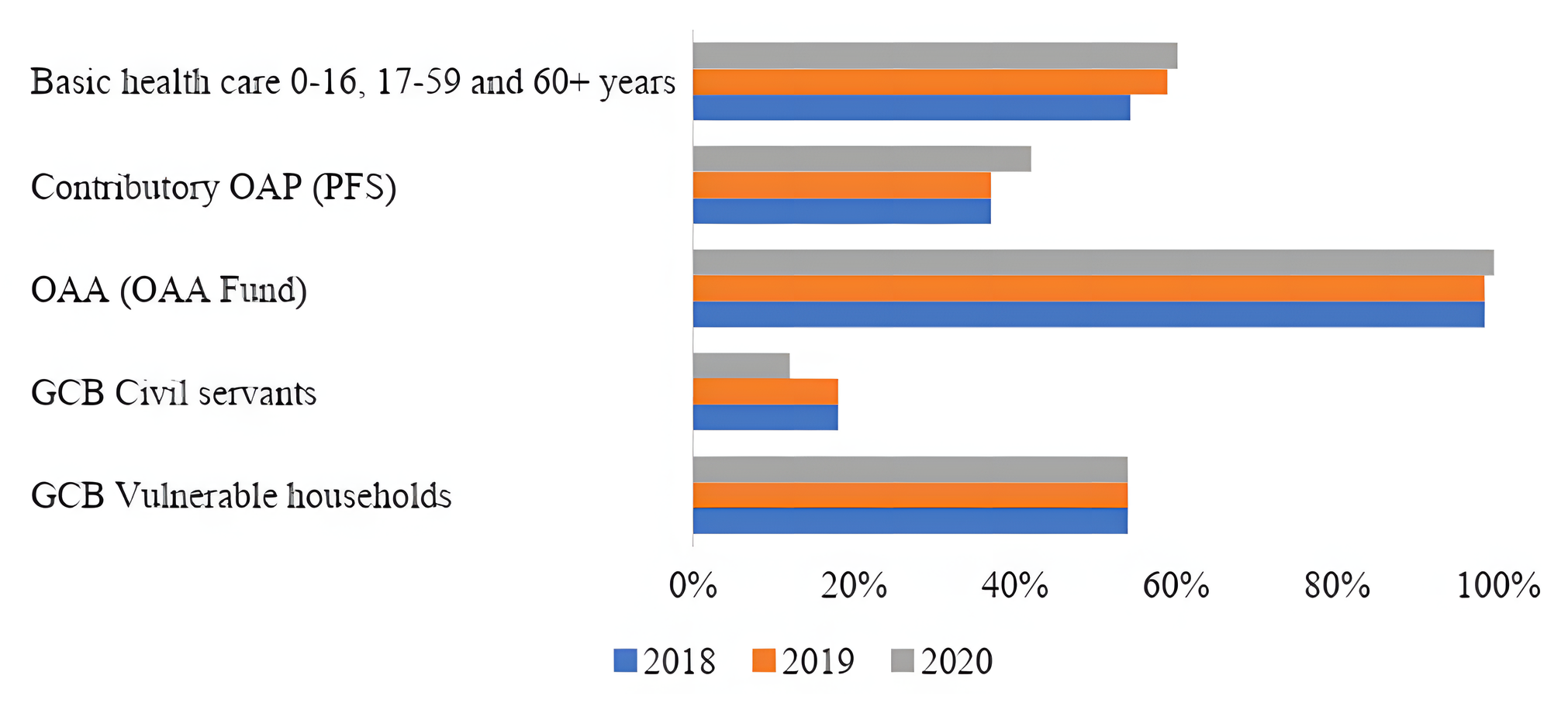
Making an estimate of the financial gap in social protection in the period we analysed (the years 2018–2020) has proved to be a challenge due to incomplete detailed data on financing and coverage in the five social areas (children, people with disabilities, maternity, older people and the unemployed) and essential health care including reproductive, maternal, newborn and child health; infectious diseases and non-communicable diseases and service capacity and access. Figure 1.1 (below) gives an idea of the coverage when it comes to cash transfers for children, older people and vulnerable households. Only in the case of the non-contributory Old Age Allowance is the coverage almost 100%.
Figure 1.1 Coverage of social protection3
It is important to address the issue of incomplete data since it is necessary to be able to calculate the financial gap in the five distinguished social areas for policy purposes.
Public Finance Management (PFM) challenges, bottlenecks and reform
When it comes to PFM in general and specifically for social protection in Suriname, there are different challenges and bottlenecks with budgeting, implementation and monitoring & evaluation.
Thanks to the BIS, the Ministry of Social Affairs & Housing is now able to analyse information about financial transfers at the touch of a button.
In budgeting, money is not linked to outputs and outcomes, and resources for social protection are allocated to different government agencies — in addition to those responsible for social protection in Suriname, with some cases overlapping objectives, activities, and target groups. This can usually be traced back to political reasons, e.g., competition amongst various groups for limited resources, which is translated into expenditures and takes up fiscal space that can be reallocated, for instance, to finance child-sensitive social protection initiatives. When striving to accelerate the extension of social protection, it is important to discourage fragmented schemes and, with this, improve cost-efficiency among social protection programmes.
With regards to implementation, the mechanisms for enrolment and selection and payment modalities are not inclusive and common across different social protection provisions, which results in inefficiency and therefore in the loss of funds intended for financing those provisions. To reduce or prevent this issue and improve cost efficiency, it is important to improve enrollment and selection across different social protection provisions by adapting simplified administrative procedures while harnessing digital technology.
In the case of monitoring & evaluation, the required information — e.g., administrative non-financial performance information — is sometimes absent or usually not available in the form needed. It is, therefore important to set up common systems for information management across several programmes to reduce costly overlaps and improve transparency and accountability.
Revolutionising services through digitalisation
In 2021, the Ministry of Social Affairs & Housing started the digitalisation of services to target groups by developing and putting into use a Beneficiary Information System (BIS). The purpose of this system was to digitalise the application process for social assistance while giving beneficiaries the opportunity to follow the status of their application. Thanks to the BIS, the Ministry of Social Affairs & Housing is now able to analyse information about financial transfers at the touch of a button. This contributes to improving the monitoring and evaluation of the different financial provisions.
In the same year — in order to improve the payment of cash transfers such as General Child Benefit, financial assistance for vulnerable households and people with disabilities and Old Age Allowance — the Ministry of Social Affairs & Housing took the first step to financial inclusion by going from cash to cashless payments. The purpose of this transition was to transfer all financial benefits via a debit card system (digitisation) without stakeholders needing to open or have a bank account, making it easier for them to gain access to the funds.
Done reading? Make sure to share your own thoughts on providing social protection services more effectively by leaving a comment below ⬇️

Log in or sign up to continue the conversation