
Following a groundbreaking new law, all large UK firms have recently been forced to work out and publish their gender pay gaps on an online portal. Companies are being named and shamed, and all are required to show the public their plans for how to fix the problem.
The revelations have brought the pay gap back into the heart of public debate in the UK, with figures showing that eight in 10 UK firms pay men more, that not a single sector pays women more, and that men make up the majority of higher-paid jobs and have the highest bonuses.
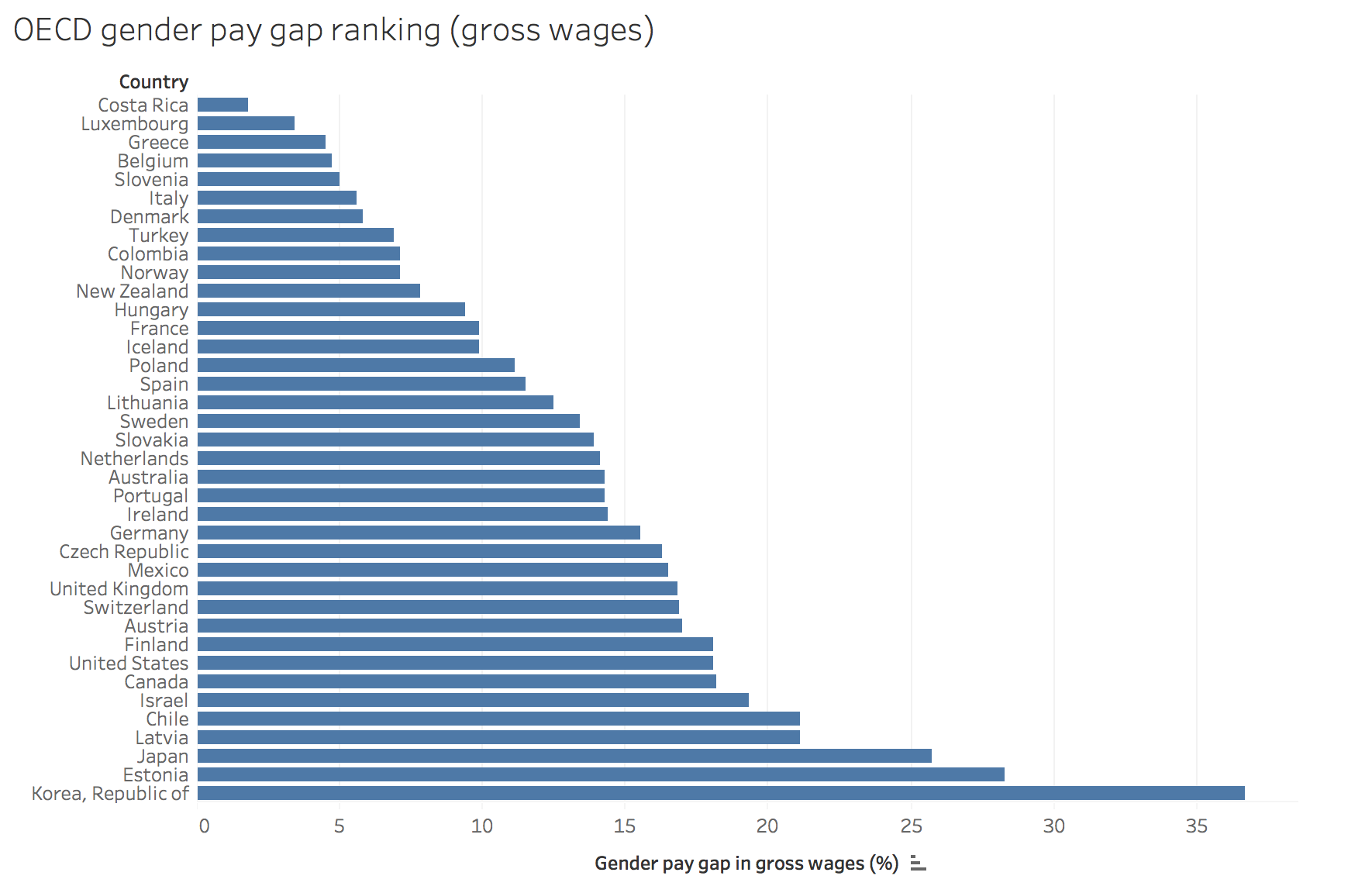
But how is the UK performing internationally, and what is the gender pay gap picture across the globe? Seeking to answer such questions reveals real limitations with this increasingly high-profile measure. Here’s why the pay gap, while an emotive issue, is not always the most useful figure to establish different countries’ performance on gender equality at work.
Mapping the pay gap
The gender pay gap is usually taken to be the average difference between men’s and women’s earnings, expressed as a percentage of men’s earnings. But differences in sources, definitions and methods used to calculate the gap make directly comparing different countries’ performance highly problematic.
Some pay gap figures include all workers, some just full-time workers. A pay gap measure is unlikely to include informal workers — like domestic workers or street vendors — but it may do. And, critically, it may measure earnings by hour, week, month, or year.
UK firms were forced to report on gender differences in hourly pay, but that’s a figure many countries, including the US and Australia, don’t systematically report for all workers. Hourly pay gaps also tend to be smaller than monthly or yearly ones, as they fail to capture the fact that on average women have to work fewer total hours due to family responsibilities.
More countries report annual or monthly figures, but even that data is of mixed quality and hard to compare — some figures are based on household surveys, others on official data collected via tax returns which misses out on those working informally.
And the lack of reliable data broken down by sex in many countries sometimes conceals the existence of a pay gap and other times undervalues it. For example, ILO hourly wage figures suggest multiple Latin American countries as well as Malaysia and Brunei all have precisely zero pay gaps; statistically unlikely, more probably a result of imprecise data.
All of this makes directly ranking all countries’ gender pay gaps on one scale a challenge that even the UN, ILO and World Bank are yet to conquer.
Is Saudi Arabia really performing better on gender equality than the Nordic countries?
Even beyond these measurement difficulties, the gender pay gap — accurately measured — can still be a misleading and uninformative indicator of women’s equality at work.
Take Egypt, for example. According to ILO data, its hourly gender pay gap is as low as 11.5%, and its monthly gap is 19.3%. Both figures are better than the UK, and even better than Iceland, regularly ranked the global number one country for gender equality.
Meanwhile, Saudi Arabia’s monthly pay gap, according to ILO numbers, is just 8.2%, beating the Nordic countries as well as the US, UK and France. But in Saudi Arabia women can’t make major decisions without their husband’s permission or freely interact with men, and they have only just won the right to drive.
So, what’s going on?
The pay gap misses a critical part of the picture; it only counts those that are employed and says nothing about the share of women that don’t or can’t take part in the formal paid labour market at all.
Women that take care of their homes, children and grandchildren and don’t have time to work for money, those that work informally as cooks or cleaners, and those who are prevented from working by cultural barriers and gender norms – what women can and can’t do — all are not considered by the pay gap.
And, in countries in the Middle East, for example, only small numbers of women actually have paid work compared to men. In Egypt and Saudi Arabia, only three women are employed for every 10 men.
The monthly or hourly pay gap for the minority of employed women — just 20% of women in Egypt and Saudi Arabia are formally employed, compared to 60% in Canada, Australia and Sweden — says little about average gender inequality in the country.
Simply comparing average wages when the participation rate of women is very low compared to men will likely lead to a small-ish pay gap; it may well be the more advantaged and educated women who work. And, if only few women — those with relatively high levels of education — enter the labour market, employed women will be on average more qualified than employed men, further narrowing pay gap figures.
Without — at the very least — an understanding of levels of gender inequality in access to paid work in the first place, ranking countries by gender pay gap is unhelpful at best, and misleading at worst.
You would never know that Iceland, where seven in 10 women work formally and the ratio of women to men employed is more than 90%, is a good place to be a woman at work. And you might think that some places had simply sorted out any issue of economic gender equality.
As a recent ILO report on the topic put it:
“There are major problems in providing good data on the size of the gender pay gap…. There are clear problems in simply comparing averages when the participation rate of women is very low compared to that of men …. Either way gender gaps do not provide a good indicator of the state of gender equality.”
(Picture credit:Flickr/UN Women)
Odette Chalaby
꼭 아래 댓글을 남겨 작성자에게 여러분의 생각을 공유해보세요

계속 대화를 하려면 로그인하거나 가입하세요