
This article was written by Carlos Santiso, division chief for innovations in citizen services at the Inter-American Development Bank (IDB). If you’re interested in writing an opinion piece, take a look at Apolitical’s guide for contributors.
In 2015, the United Nations proclaimed a “data revolution” in light of the exponential increase in data driven by digital transformation of governments. In the era of "fake news" and so-called "alternative facts," the value of data has taken on new relevance. Not only data transparency, but also data integrity is essential to bolstering citizens' trust in governments. As the American statistician William Deming said, "In God we trust, all others must bring data."
A few weeks ago, open data enthusiasts gathered in Tbilisi, Georgia to take stock of the progress made through the Open Government Partnership, a global initiative launched in 2011. Since then, international standards such as the International Open Data Charter and the G8 Open Data Charter have emerged.
The hypothesis behind these efforts is that opening up government data contributes to reducing corruption, empowering citizens and improving public services. It is estimated that open data could reduce corruption by up to 10% in G20 countries. It is also projected that by 2020, the use of open data could reduce the costs of the European bureaucracy by up to €1.7 billion ($1.9bn).
Progress…
A recent study by the Inter-American Development Bank (IDB) assessed open data progress in Latin America and the Caribbean. It showed significant achievements — and formidable challenges. In recent years, most countries in the region have launched ambitious open data programs and created one-stop shops to facilitate access to open data in a user-friendly way.
Argentina, Brazil, Colombia, Mexico, Panama, Peru, and Uruguay have adopted national policies and created portals, opening up a wide variety of databases on health, education, security, budget and public services to the public. These efforts are bearing their first fruits: five countries of the region (Argentina, Brazil, Colombia, Mexico, and Uruguay) are now among the 20 countries with the highest scores in the Global Open Data Index.
Underpinned by its National Digital Strategy, Mexico has achieved significant progress, earning 11th place globally and 1st place regionally in the area of open data. Mexico City is the first city to disclose information on all its public tenders, in accordance with the Open Contracting Data Standard. It is also important to display data in user-friendly formats to facilitate their use. The Observatorio del Gasto and Gobierno Fácil are other examples of data visualization platforms in Mexico that facilitate data use by civil society, and DataChile is an example in Chile.
… and challenges
In general, according to the Open Data Barometer, which assesses the open data ecosystem, the Latin America and Caribbean region lags behind in terms of society’s readiness to absorb and use data. This is due to four main types of challenges.
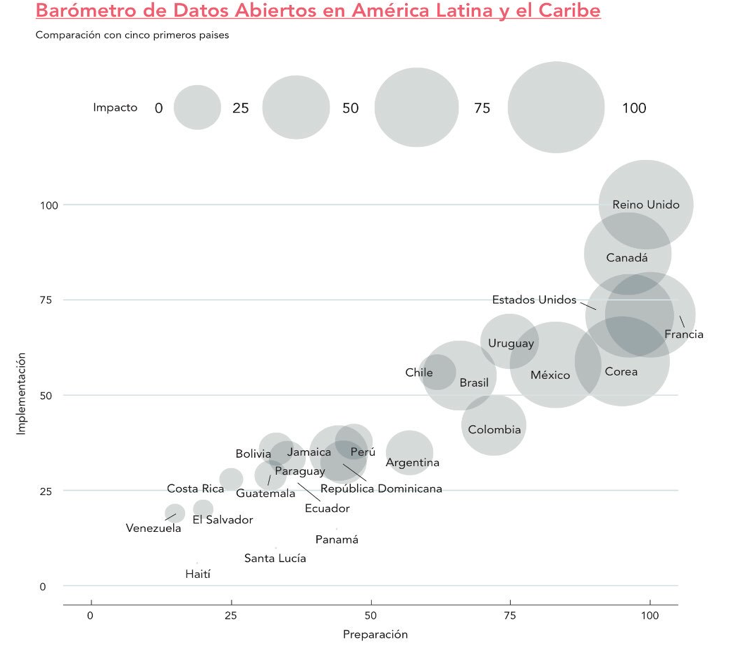 Source: IDB, 2018, p.51.
Legal challenges
The region should continue to strengthen its legislation on access to public information and personal data privacy, as well as improve regulation on data governance and the responsibilities of generating and disseminating data in reusable formats.
Political challenges
Beyond legal and technological barriers, open data faces resistance from people who control information, as information is power. It is a telling sign that 12 countries in the region have interoperability platforms, but on only three of these are all public entities interconnected. Public entities remain bureaucratic silos reluctant to share information, even among themselves. Open data makes it possible to circumvent this challenge.
Additionally, there is sometimes the temptation to manipulate data to disguise failures and capture data for political purposes. As the Nobel laureate in Economics Ronald Coase reminds us: “If you torture the data long enough, it will confess.” Political economy factors are decisive reasons why some countries invest in their statistical capacity or the independence of their statistical institutes while others do not, as another IDB study shows.
Institutional challenges
A third type of challenge has to do with the effective use of data to inform public policy based on empirical evidence of what works and what does not. There is still no data-driven culture in government administrations. So far, and paradoxically, open data has coexisted with high levels of corruption in the Latin American and Caribbean region.
In this context, data intermediaries can play a key role in making effective use of data to create knowledge, raise awareness and change behaviours. Civic-tech organisations and government agencies themselves — particularly oversight agencies — play a key role in detecting and preventing abuse and dishonest attitudes toward public funds.
Economic challenges
The fourth challenge lies in using data to create economic value. Data entrepreneurship by creative start-ups is a growing and promising industry. In Mexico, for example, the Labora platform seeks to encourage entrepreneurs to use open data in the new data economy. The economic value of data is enormous and growing. In Spain, the new sector of infomediary companies generated €1.72 billion ($2bn) in 2016.
A long-distance race
Without a doubt, Latin American and the Caribbean has achieved remarkable progress in open data. The technology is there, demand has grown and political will has seemingly aligned with the cause. Nevertheless, the digital race continues to heat up and if we do not catch up, we risk being left behind. — Carlos Santiso
(Picture credit: Pexels)
Make sure to share your own thoughts with the author by leaving a comment below

Log in or sign up to continue the conversation