
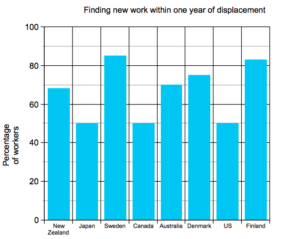
If you’re going to get fired, do it in Sweden. There, around 85% of laid-off workers find new work within a year. No other OECD country does re-employment better. But the really remarkable thing is this: government is barely involved at all.
It's all down to the close cooperation of employers and unions, in a country where around 70% of workers still belong to them. Together, independently of the state, they hammer out binding documents known as “collective agreements” that guarantee workers’ rights.
These can be local and apply to one company, or nationwide and apply to a whole industry. They contain the regulations that keep both sides happy, including minimum wages, holidays and sick pay. But they also hold the secret for getting laid-off workers back into work: job security councils.
Job security councils are private organisations unique to Sweden. When layoffs are agreed, they step in to help, catching workers before they fall out the workforce and launching them back in.
Sweden's private safety net
“If a company decides they have to lay people off, they negotiate with the trade union and decide which people will be affected,” said Caroline Soder, CEO of Trygghetsfonden (TSL), the job security council for blue-collar workers. “Then they contact their job security council and we send our people out to the workplace to inform those who are being laid off. We talk with all of them individually about their thoughts and what they think they need. Then we discuss how we can support them.”
There are over a dozen job security councils, each for a different sector. Some, like TSL, cover almost a million workers. Others cover just a few thousand. But all are privately funded by the companies that employ those workers, to the tune of around 0.3% of their annual payroll.
Each council offers services that fit the labour needs of their industry. Broadly, this may include job coaching, from writing a CV to interview training and finding open positions. Or it may include vocational training and having skills formally certified. All these services are free—and further financial support can be provided for education, in addition to a stipend that helps the workers support themselves until they find new work.
“It’s a black box model with a lot of different tools,” said Soder. “But the coaches have regular contact with the participants until they find another job.”
What's important is that the help is personalised, and it comes quickly - because the longer someone is out the workforce, the harder it is for them to get back in.
Across all job security councils, 85% of laid-off workers are back in work within the year. But when you separate them, it’s clear that white-collar workers fare somewhat better: 65% of them find a new job within six months. Given the length of notice period in Sweden, this means they might not spend any time unemployed at all.
But the fact that Sweden’s blue-collar workers get back into work as well as they do is perhaps even more remarkable. Around 40% of them have a job within six months, but that figure rises to 80% within a year—not far off the average across job security councils.
For developed countries struggling to deal with the loss of manufacturing jobs, this should grab their attention.
Admittedly, not all jobs are equal. Roughly 60% find a new job that has equal or better pay than their last, but 40% end up accepting less pay, at least to start with. About half return to jobs that are equally skilled, whereas 24% and 17% find work that is more and less skilled respectively. Only 2% end up relocating to find work.
It’s not perfect, but the headline statistic - that 80% of blue-collar workers are back in work within a year - is not deceptive. People are generally finding jobs similar to what they had before.
How do job security councils compare to government programs?
According to an OECD report, job security councils are more effective than government programs because they intervene immediately after a layoff. They also have financial resources that public employment services, which also exist in Sweden, cannot provide.
The result is that Sweden’s back-to-work rate for displaced workers is the highest among OECD countries. Where the US and Canada have only 50% back to work within a year, Sweden has 85%.
“The infrastructure that we have in Sweden is very important,” said Soder. “Our organisation is a continual presence, not just during crisis. This allows us to meet the structural changes in the labour market that are not related to the cyclical ups and downs of the economy—they are more important than that. We have a culture within which we anticipate and adapt to changes, instead of resisting them.”
Can the model be exported?
Readers from outside Sweden may look at the combative labour relations in their own country and have one question: how were companies persuaded to sign up and foot the bill?
The answer is partly historical and cultural. Unions are still strong in Sweden, but in the past, they were more so—and more militant. So there was greater pressure on companies to compromise. But Sweden also has a tradition of collectivism: people are happier to pay for things that may not immediately or directly benefit them.
But all that aside, job security councils are a good investment. They make the economy more dynamic because they make it easier for companies to shed unproductive divisions without union resistance. Workers are then retrained and return to the workforce more productive. Job security councils make this transition easier. They don’t resist restructuring—they enable it.
“It helps companies in their negotiations with the unions,” said Soder. “It’s easier to have this dialogue if you know that, on the other end, even if you have to lay off workers, you have this support.”
 Sweden has one of the highest labour participation rates in the OECD
Go beyond the companies, and job security councils influence the health of the overall economy. In countries like the US, a growing number of people are dropping out the workforce for good, and that depresses consumer spending. What’s more, if people aren’t finding jobs that are a better fit for their skills, they aren’t being as productive as they could be—and that shrinks the economy.
Turn to Sweden and the picture is rather different. It manages to have both one of the highest labour participation rates in the OECD and one of the most generous welfare programs to support the unemployed. Its economy is among the best performing in the EU and it came through the 2008 financial crisis mostly unscathed. Clearly, job security councils aren’t entirely responsible for this, but economists agree that they certainly contribute to the health of Sweden’s labour market.
Still, it's unclear how the job security councils would cope in a weaker economy, with more dramatic layoffs, or with a labour market leaning towards temporary contracts.
What lessons can be taken from Sweden? Unions are historically weak in many developed countries, so the whole concept of job security councils can't just be lifted over borders. But the economic argument could be made. At the very least, their success underlines the importance of a quick intervention when getting people back to work.
“Each and every country has its context and structure,” said Soder. “That’s right in one way, but it always helps when people and companies have some kind of insurance to help society move through transitions. And I believe that other countries can adapt this model to their specific conditions.”
(Picture credit: Flickr/square(tea), Flickr/Jess Cheng)
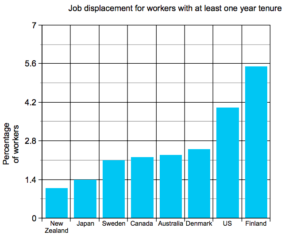
Data for the graphs came from the OECD Back to Work series. They represent averages from varying numbers of years.
Make sure to share your own thoughts with the author by leaving a comment below

Log in or sign up to continue the conversation