
Dans le quartier Vauban de Fribourg, il n'y a pas de places de parking : les voitures sont reléguées dans deux parkings à plusieurs étages à la périphérie du quartier, laissant la majorité de la rue aux piétons et aux cyclistes. De nombreux résidents vivent dans des «maisons passives» sans système de chauffage central conventionnel , qui tirent la chaleur des façades orientées au sud, des fenêtres à triple vitrage et de l'isolation des murs. D'autres types d'habitations sont également très économes en énergie: on estime que le quartier utilise environ 50% de l'énergie d' un quartier ordinaire.
Vauban est connue pour être la partie la plus verte de la ville la plus verte d'Allemagne. Située dans le sud-ouest de l'Allemagne, au pied de la Forêt-Noire et de la montagne Schoenberg, Fribourg a été proclamée capitale de l'Allemagne pour la protection du climat en 2010 , et a gagné une renommée internationale à l'expo mondiale de Shanghai la même année.
"Il y a une meilleure qualité de l'air, beaucoup moins de bruit et beaucoup moins de risques d'accident"
«Il y a une meilleure qualité de l'air, beaucoup moins de bruit, beaucoup moins de risques d'accident, des chemins plus courts et plus nombreux entre les rues, et beaucoup d'argent est économisé pour les personnes qui n'utilisent pas de voitures», a déclaré Andreas Delleske , développeur de logiciels et résident de Vauban qui guidait les visites des visiteurs dans le quartier.
«Grâce à l'utilisation réduite des voitures, les transports publics de la région transportent beaucoup plus de passagers. Notre système de tramway est plus efficace et économiquement durable que beaucoup d'autres. »
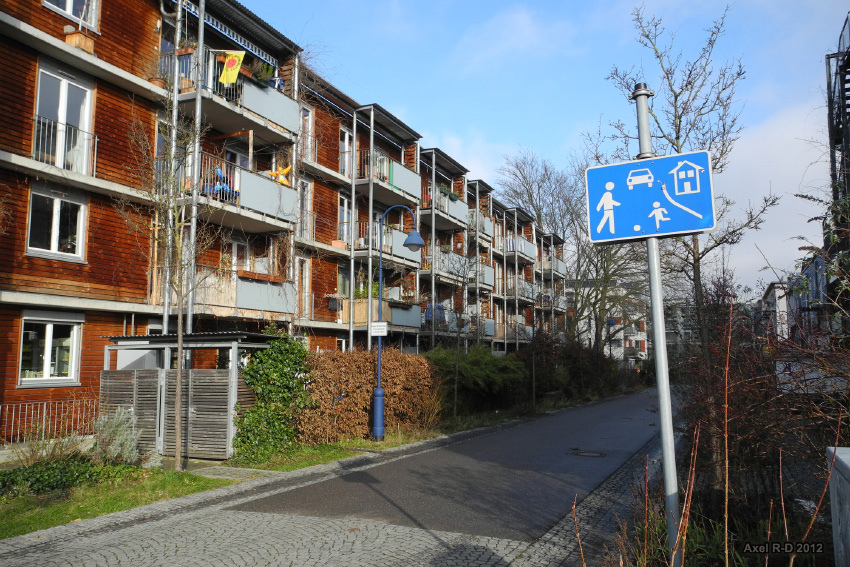 Le logement à Vauban gaspille beaucoup moins d'énergie qu'ailleurs en Allemagne
La durabilité a été intégrée dans l'environnement au fil des ans à travers des conversations - et parfois des conflits - entre les résidents et la ville.
«Il y a eu de nombreuses négociations constructives mais aussi longues», a déclaré Delleske. «Dans tous les différends bien connus que je connais, à la fin du processus, il a été constaté que les citoyens avaient raison.»
Mais tout cela est né de quelque chose de très différent, dont le souvenir est montré à Haus 037, une ancienne caserne maintenant utilisée comme jardin d'enfants, centre religieux et restaurant.
"Si l'Allemagne a appris quelque chose des deux guerres mondiales, alors j'espère que les citoyens ne peuvent pas simplement abandonner leurs responsabilités sur le stand électoral"
Jusqu'en 1992, les seuls habitants du Vauban étaient des militaires français qui occupaient le quartier depuis la fin de la seconde guerre mondiale. Suite à la chute du mur de Berlin et à la réunification de l'Allemagne de l'Est et de l'Ouest, les troupes ont déménagé, laissant leurs casernes vides et les rues désertes. Puis de nouveaux résidents ont emménagé pour occuper les bâtiments vides: étudiants, parents seuls et personnes à faible revenu se sont regroupés pour former l'organisation SUSI (Self-Organised Independent Settlement Initiative). Depuis lors, la croissance du quartier a été portée par des militants écologistes et des idées radicales.
Il y a eu des différends sur l'opportunité de démanteler ou non toutes les casernes, plutôt que de les rénover - finalement, la ville a accepté de rénover la Haus 037 en un centre culturel.
"Il y a un public critique à Fribourg depuis le début des années 70", a expliqué Delleske. Dans les années 1970, des militants locaux se sont opposés avec succès au projet de construction d'une centrale nucléaire près de la ville. Le caractère du quartier a depuis été motivé par les idéaux des squatters qui ont initialement emménagé.
"Fribourg a certainement eu de la chance car c'est une ville universitaire: pour les étudiants, au moins, il était possible de consacrer une ou deux années non rémunérées au projet", a déclaré Delleske. "Si l'Allemagne a appris quelque chose des catastrophes des deux guerres mondiales, alors j'espère que les citoyens ne peuvent pas simplement abandonner leurs responsabilités au bureau de scrutin. J'espère que c'est le cas pour la majorité dans la ville."
En 1994, la ville a ouvert le développement du quartier à un concours public . L'entreprise gagnante, Kohlhoff & Kohlhoff, a été chargée de créer un quartier mixte résidentiel et de travail pour différents groupes sociaux, avec une préférence intégrée pour la marche, le vélo et les infrastructures de transport public aux côtés de logements à faible consommation d'énergie. Les premiers nouveaux résidents ont commencé à emménager en 1998.
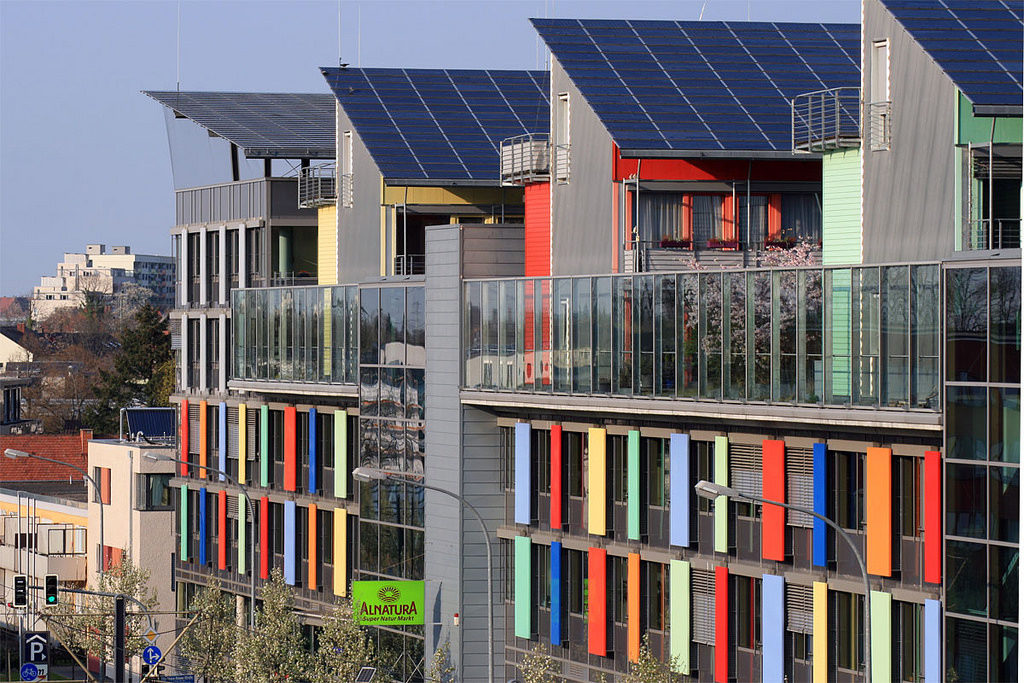 Le vaisseau solaire de Vauban
Vauban est la zone la plus densément peuplée de l'ensemble de Fribourg: plus de 5 000 personnes dont l'âge moyen est de 28,6 ans vivent sur 41,6 hectares de terrain, dont 2,6 hectares d'espace vert. Les deux pièces maîtresses du quartier sont le Sunship, un bloc de logements entièrement alimenté par l'énergie solaire, et l' Heliotrope , un bâtiment en verre qui tourne pour suivre le soleil et qui tire cinq fois plus d' énergie du soleil qu'il n'en utilise.
"Les autorités municipales devraient accepter que les citoyens critiques ne soient pas toujours des gémissements et des corps occupés"
Avec la croissance, le quartier est devenu plus cher. En 2012, le loyer moyen d'un appartement neuf à Vauban était de 750 € (922 $), contre 691 € en moyenne (849 $) à Fribourg. Pour certains résidents, la mixité sociale de la région n'a pas été à la hauteur des débuts radicaux de Vauban, et est maintenant plus un paradis pour les classes moyennes soucieuses de l'environnement .
Les bâtiments de la ville ne doivent utiliser que 65 kWh d'énergie par mètre carré, contre 75 kWh dans le reste de l'Allemagne. Les maisons passives n'utilisent que 15 kWh. Les bâtiments emblématiques du quartier, le Sunship et l'Héliotrope, sont conçus pour repousser les limites. Ils ont tous deux été conçus par Rolf Disch , un architecte local et ancien militant lui-même. Malgré ce pedigree militant, Delleske tient à souligner qu'aucun des résidents n'est obligé de participer.
"Le quartier Vauban est en fait tout à fait normal depuis le tout début", a-t-il déclaré. "Tout le monde peut suivre son propre chemin, et personne n'est dérangé par aucune pression sociale."
La possession d'une voiture à Vauban n'est pas interdite , mais est rendue difficile par le manque de places de parking. Certains résidents ont déclaré que des voitures laissées dans les rues avaient été endommagées par d'autres résidents et ont fait remarquer la pression des pairs de leurs voisins. La différence entre le quartier et Fribourg plus large est claire: dans la ville, il y a en moyenne 495 voitures pour 1 000 adultes; à Vauban, il y en a 85 . Cela laisse plus d'espace disponible dans les rues pour permettre aux piétons de marcher et aux enfants de jouer.
Reste la question de savoir si le modèle Vauban pourrait être reproduit ailleurs. Peu de villes sont susceptibles de trouver une zone dans laquelle planifier et construire un nouveau développement du jour au lendemain, et les succès du Parti vert dans le gouvernement local de Fribourg ont soutenu le développement écologique dans le district. L'exemple prouve cependant que l'urbanisme fait en tenant compte de l'environnement est possible.
"Nous avons tout simplement saisi les chances d'améliorer la façon dont la construction est réalisée", a déclaré Delleske. "Les autorités municipales devraient essayer d'accepter que les citoyens critiques ne sont pas toujours de simples gémissements et des corps occupés, mais sont une impulsion nécessaire à un meilleur développement urbain. En outre, ils doivent toujours être écoutés et alloués des ressources qu'ils peuvent utiliser pour organiser et coordonner. "
(Crédit photo: Flickr / micagoto / Axel Drainville / Stadt Freiburg)
Anoush Darabi
anoush.darabi@apolitical.co
N'oubliez pas de partager vos propres réflexions avec l'auteur en laissant un commentaire ci-dessous

Connectez-vous ou inscrivez-vous pour continuer la conversation