
“We were in Cape Town for a lecture at the Design Indaba in February 2012; we’d come a long way,” said Alfredo Brillembourg, architect and co-founder of Urban Think Tank (U-TT), a collection of social thinkers and designers based in Switzerland. “We asked the audience how many of them had gone into a township: very few people raised their hand in what was a primarily white audience.”
Following the lecture, Brillembourg turned down one of the conference’s perks, a helicopter ride to Cape Point. Instead, he asked the pilot to fly over the Cape Flats, the largest area of informal settlement in Cape Town.
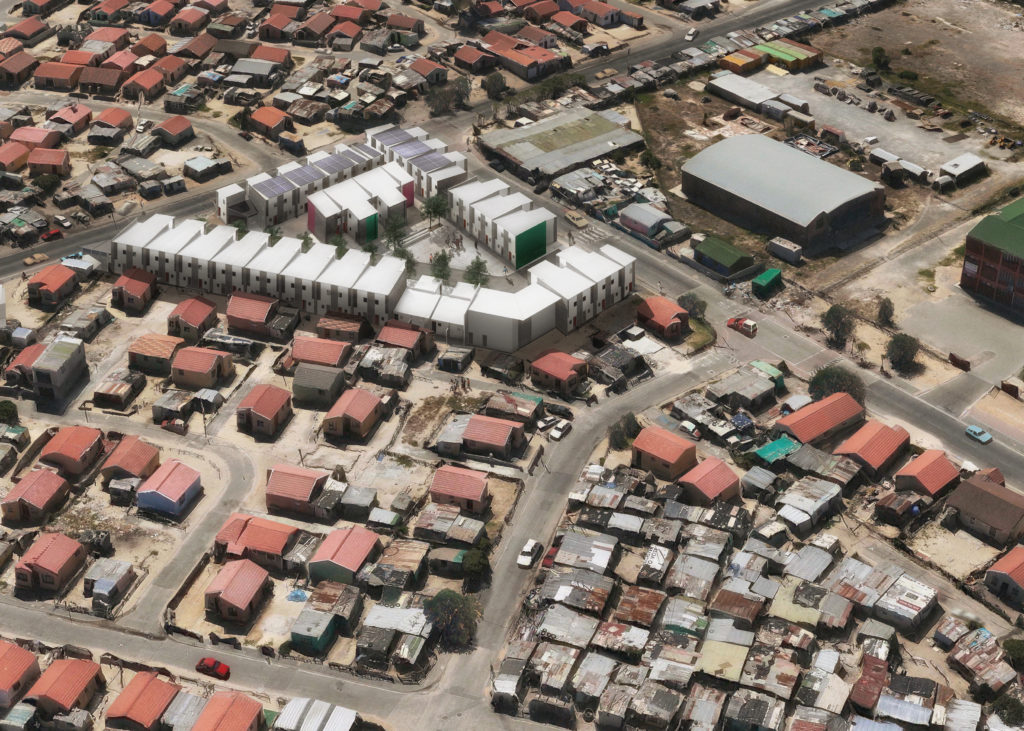 The two-storey Empower Shacks are built densely to use available space as efficiently as possible
“I saw an unbelievable sea of tin shacks, and thought, wow, this is an incredible disaster. When I landed I asked my friends in Cape Town if they could point me in a direction where I could walk in on foot.”
Since the collapse of Apartheid in the 1990s, South Africa has struggled to deal with the social and economic problems stemming from the era. One of the biggest is housing. Over the past few decades, migration into urban areas has rapidly increased, and housing has failed to keep pace. In the informal settlements on the edges of cities, residents continue to build their own accommodation from cheap materials. Water and other essentials are hard to come by; violence and crime prevalent; homes vulnerable to flooding; and sanitation poor.
“There’s not enough land. We need a denser scheme, which is how they used to make cities"
Through the Reconstruction and Development Program (RDP), first announced in 1994, the South African government has subsidised home-building for citizens. Although it has built over four million units, there are still huge shortages. The city of Cape Town recently estimated there to be a housing backlog of 350,000 in the city. However, in October 2017, critics suggested that at the current growth rate in Khayelitsha, a township on the Cape Flats, residents will have to wait 60 years for a house.
Brillembourg's idea is to transform the slum shacks themselves into durable houses. If successful, it could be replicated across the country, helping to alleviate its housing crisis.
Empower Shack
After visiting Khayelitsha, Brillembourg proposed that government should make use of the existing informal settlements, rather than fixate on offering every citizen a plot of land for a suburban-style house.
“Pretty much everyone is convinced that (RDP housing) cannot be done anymore,” said Brillembourg. “There’s not enough land. We need a denser scheme, which is how they used to make cities around the world - like in New York or London.”
U-TT worked with the community in Khayelitsha on a new prototype for two-storey, narrow buildings made from cheap but durable materials. This would allow more people to be housed in a particular area, whilst also preserving the model of one family per shack. In 2014, they erected a house for Phumezo Tsibanto, a community leader. The resulting building was more durable, warmer, cleaner, and didn’t flood during heavy rains.
https://www.youtube.com/watch?v=OJrd1GQFWNA
With this original shack serving as a demonstration of the concept's viability, U-TT has now built 24 buildings, called “Empower Shacks”, with plans to eventually complete 72. The two-storey structures have permanent footprints and are built back-to-back and side-to-side in dense, terrace-like rows. They are built in eight different sizes, with core sanitation and kitchen facilities which can then be upgraded over time according to residents' preference and financial capability.
“When we build, we build the shell, and the community finishes and fits the inside,” said Brillembourg. “Because we know it’s going to take a long time to really put their kitchens, their bathrooms, their installations inside. They can still move in and you get them out of the slum condition quickly.”
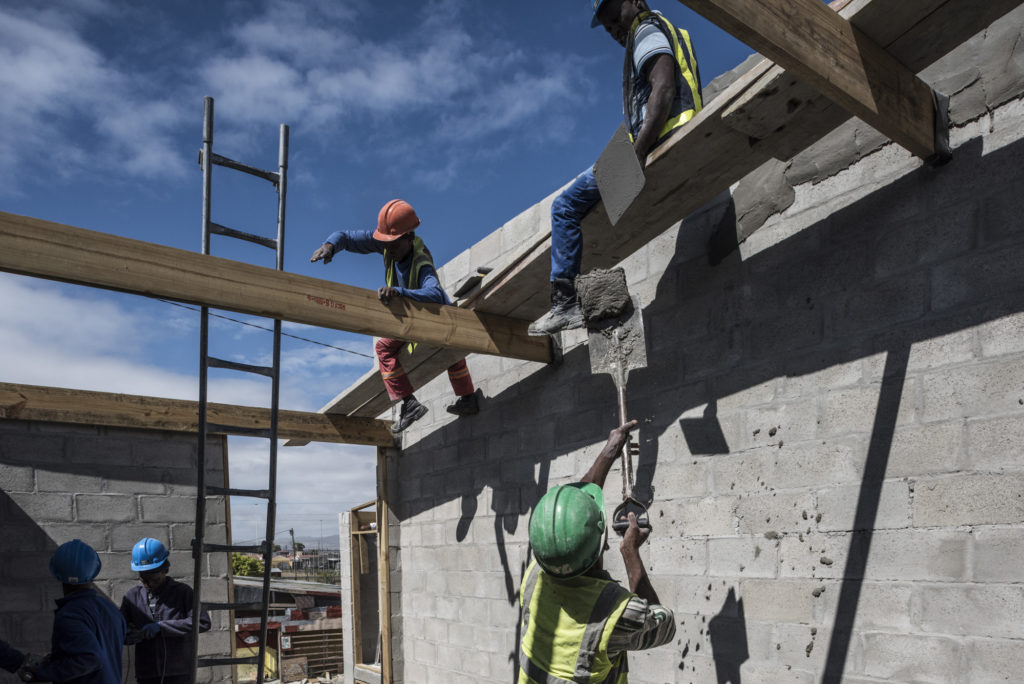 Empower Shacks can be built quickly from cheap materials
Consultation and collaboration
Redevelopment requires mediation, as residents want to continue to live near their neighbours and have a say in how their new homes are built. To this end, U-TT developed a digital tool that allows residents to be woven into the planning process for developments. Residents are able to modify the position of their house with an interactive map, automatically reconfiguring the adjacent homes to fit the new pattern. It is designed to digitalise the planning process, enable mediation between individual and community preferences and the local planning framework.
"Basically it’s an iPad with a Google Map," said Brillembourg. "It vectorises the map, then we identify each unit and put a number and name to each: those units are then moveable, and so for each community dweller we move and change his house. The incredible thing is that the algorithm now can grab any geometry of any settlement and reconfigure it, in our set standards."
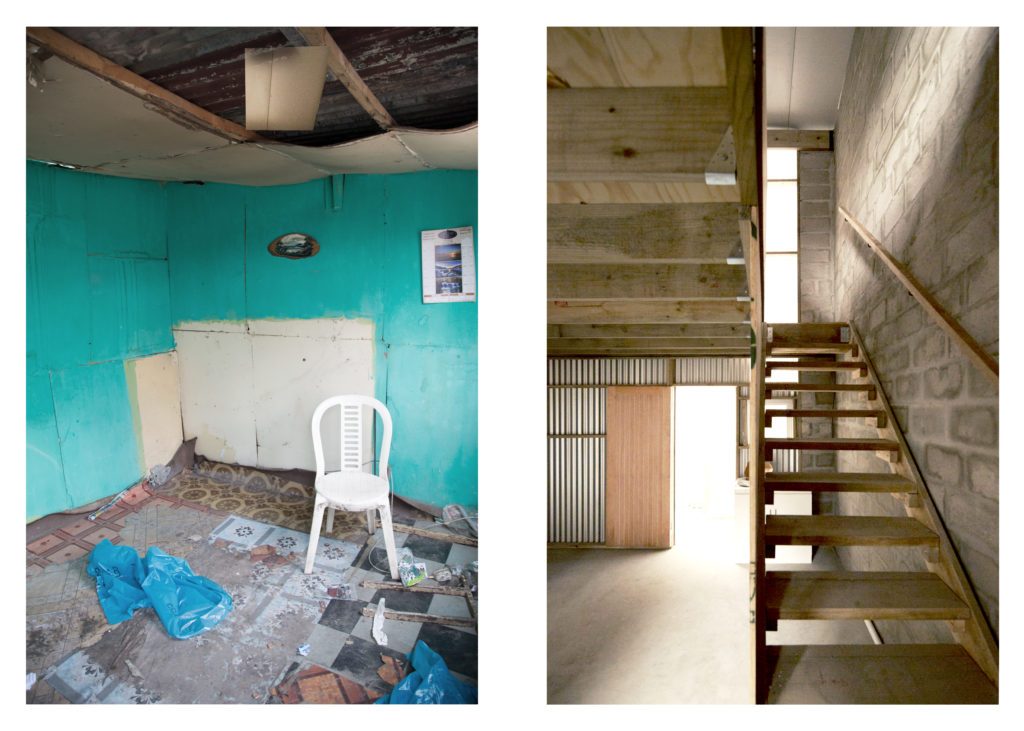 The new shacks are cleaner and more spacious
The tool builds a 3D environment which residents use to provide feedback, and prints out a blueprint, which architects use to inform their final plans. Planners can also use it to support their decision making and test out different scenarios. Residents meet weekly with representatives from NGOs and U-TT at community meetings to plan and vote on the development, the chosen contractors, and the day-to-day running of the sites.
A model to solve the housing crisis?
Empower Shack has recently been longlisted for the 2018 Royal Institute of British Architects' International Prize. In theory, it could work as a model across South Africa: it's feasible to implement anywhere with flat ground and organisations prepared to collaborate.
The politics behind such projects, and their funding, are more complicated.
In order for the program to be sustainable, residents have to be able to afford their shacks. Each one costs $8,000-$10,000 to build and the existing developments were financed through a micro-loan scheme. After individual assessments revealed that residents could feasibly make net contributions of between 10-25% of the unit construction costs, U-TT partnered with a micro-finance provider to give them access to credit to be repaid over a 36 month period. Contributions are dependent on both the size of the unit and how much land from the current shack footprint is released to the project.
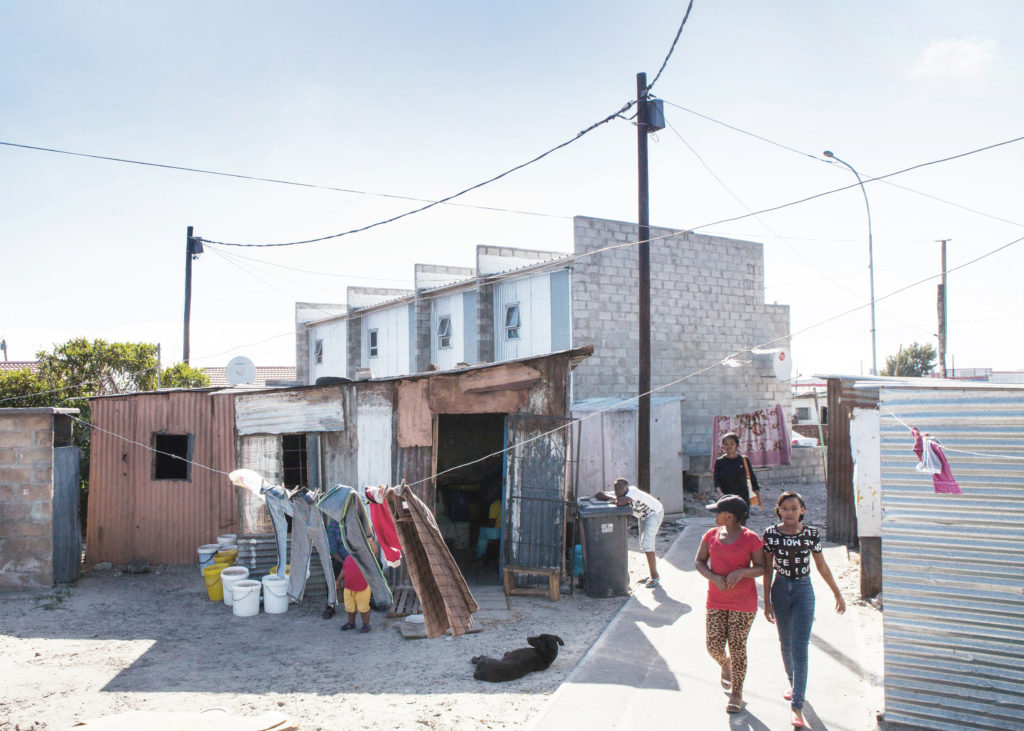 The rebuilt shacks have become community hubs
Attracting the funding to get the projects off the ground is another difficulty. The prototype and initial project were financed with 100,000 Swiss francs ($105,113) from around 100 private donors. The city of Cape Town provided some funding, but this was hard to come by. As a result, UTT had to launch the project with its own funds.
"We were left to do our work by government; they certainly didn’t finance any of the research or the organisation of the community," said Brillembourg. "They came in once we needed permission and once we needed a real construction site, and asked us to submit all of the research end-points. And so we did, transparently, and we built trust within government, which was super difficult."
The initial 24 shacks were built on municipal, rather than residential land. U-TT envisages that the government will eventually transfer over ownership of the land once the buildings are settled and change its status from municipal to residential, but the relationship remains ambiguous. Until then, the residents occupy the land with an informal title.
"We built trust within government, which was super difficult"
By creating a viable prototype, U-TT was able to build in an area with few formal regulations, eventually convincing government to support the project and provide permission. Development is vulnerable to instability and changes in political will. For the scheme to make a dent in South Africa's housing shortage, government will have to play a stronger role.
(Picture credit: Dave Southwood 2018/Urban Think Tank 2015/Jan Ras 2017)
Anoush Darabi
anoush.darabi@apolitical.co
Make sure to share your own thoughts with the author by leaving a comment below

Log in or sign up to continue the conversation