
It sounds like something a super-villain from a Bond film might attempt – spraying aerosols into the stratosphere 20km above the earth’s surface to alter the climate. Yet in recent years such scenarios have stepped closer to reality: in 2022 researchers at Harvard University will launch a balloon loaded with aerosols to test exactly this.
It's unclear what the consequences of spraying aerosols into the atmosphere will be. The technology is largely untested, and brings with it its own risks. Scientists believe it could cause droughts in places thousands of miles away from where it’s deployed, and increase the likelihood of conflict. It’s unregulated, and affordable: it would require only a few billion dollars to deploy aerosols into the stratosphere, cheap enough for an individual or a single country threatened by rising sea levels to attempt deployment.
“I think it’s a plausible scenario that those things could happen in the not too distant future,” said Janos Pasztor, executive director of the Carnegie Climate Geoengineering Governance Initiative (C2G2) and former assistant UN Secretary General. “There’s a possibility that you have a few countries like the small islands, who are absolutely impacted by climate change. They will say: well, we’ve had enough of this non-action, or insufficient action of the international community, let’s get together, let’s get the support of a billionaire, or a bigger country, and get the job done.”
Because of rapidly accelerating global temperatures, ever more people are calling for the use of geoengineering to fight climate change. By intervening in the earth’s natural processes, they hope to cool the planet, either by removing carbon from the atmosphere or through reflecting the sun’s rays back into space. While these techniques may seem far-fetched, recent reports have added weight to the case that such techniques will become necessary.
In January 2017, an upcoming report from the UN’s Intergovernmental Panel on Climate Change (IPCC) was leaked to the press. The leak confirmed what many climate scientists have long suspected – that avoiding a temperature increase of 1.5 degrees Celsius looks highly unlikely: if carbon dioxide emissions continue to rise at the current rate, we have just 12-16 years before world temperatures pass that point. This would bring with it extremes of heat, droughts and flooding, and lead to famine and mass migration from affected areas.
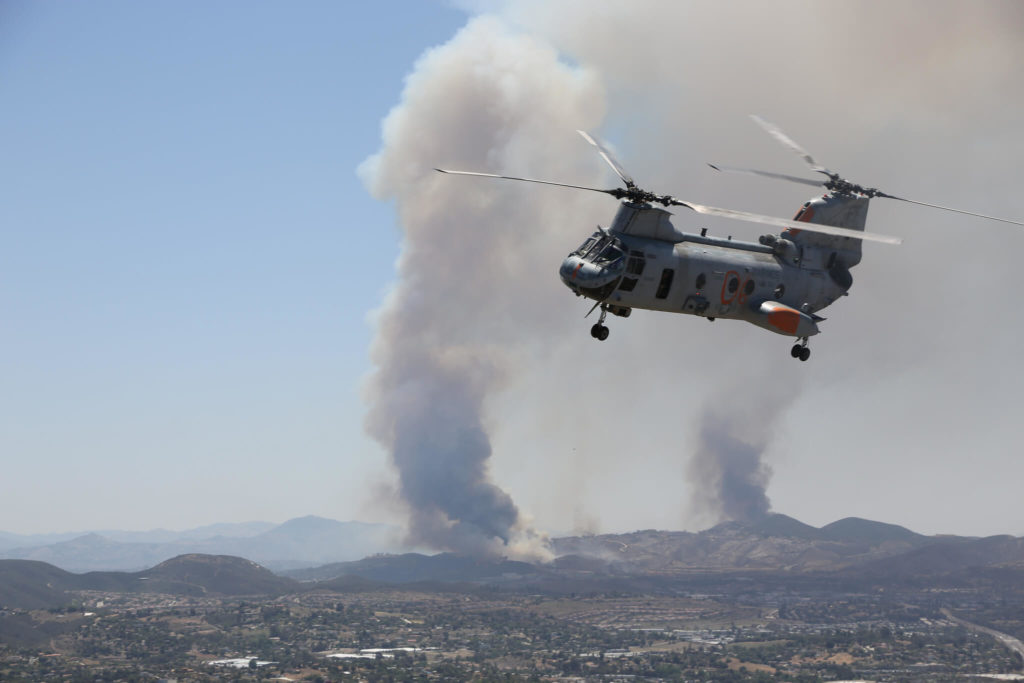 Wildfires sparked across the Western US in summer 2017
“You’ve seen the world out there, at 1.1-degrees above pre-industrial levels [the current level], and the climate can get pretty nasty,” said Pasztor. “A world of 2 degrees warming will be, qualitatively speaking, twice as nasty on the average, and we know that the real issue is not the average, but the extremes – they’re causing really serious problems already.”
In 2017, wildfires tore through the central US, burning more than one million acres in Montana alone. In 2010, extreme heat reached 46.8 degrees in Ahmedabad, India, and doubled the average daily mortality rate. Both show that even comparatively slight temperature increases are having a dramatic effect.
“According to the latest UN Environment report, we’re making about 30% of the required effort to reach the target,” said Pasztor. “Either we have to use a mixture of carbon removal options in addition to mitigation, or we have to accept that it’s going to be a very hot world and deal with it. That’s the reality.”
The risks
There are two main forms of geoengineering, carbon removal and solar radiation management (SRM). Carbon removal takes carbon dioxide from the atmosphere, for instance through planting huge numbers of trees to absorb it, or by sucking it from the air with machines and finding a means of storing it. SRM, meanwhile, reflects the sun’s rays back into space with particles sprayed into the stratosphere.
“Carbon removal could be the entry point in terms of government discussion, but our biggest challenge is actually solar radiation management,” said Pasztor. “We fear that the unilateral, ungoverned deployment of that technology by any one country, a group of countries or even a wealthy individual is a real possibility, and that’s something we have to worry about.”
Carbon removal and capture is becoming increasingly popular. In 2017, Norway announced a scheme to capture and compress carbon dioxide at industrial plants before pumping it into reservoirs beneath the seabed, and reforestation has been suggested as an option for absorbing carbon dioxide directly from the atmosphere. But the costs and land requirements of carbon capture make it a less attractive option to many than SRM: to make a dent in carbon dioxide levels, reforestation would require land three times the size of India.
While SRM may be effective in reducing the planet’s temperature, its side effects could cause damage of their own. Releasing aerosols into the stratosphere could alter weather patterns, leading to droughts or storms. Importantly, these effects might not occur in the same area where the aerosols were sprayed: aerosols released in the Northern Hemisphere, for instance, are likely to cause droughts in the Sahel or India.
"If we’d done what we should have done 20 to 30 years ago, we wouldn’t be here"
Pasztor fears such a scenario could lead to conflict. “For me, the issue of perception is more important than attribution,” he said. “One scenario, which isn’t likely but remains plausible, is that an individual country goes ahead and does solar geoengineering, and the following year the monsoon fails. Even if scientifically it would be difficult or even impossible to attribute this to the solar geoengineering, the people that are starving will attribute it to it.”
SRM remains largely untested, and unregulated. While the Convention of Biological Diversity has a framework for the use of geoengineering, the rules are piecemeal, and there are no comprehensive or multilateral rules governing research and testing. The door for deployment remains open to whoever can afford it and is willing to risk the consequences.
By 2022, researchers at Harvard University plan to send a balloon into the stratosphere to test the effect of SRM. The flight could take place as early as spring 2018. Run jointly by firm SRM advocate David Keith and his partner Frank Keutsch, the Stratospheric Controlled Perturbation Experiment (SCoPEx) will measure how a 100m wide and 1km long plume of sulphate aerosols sprayed into the stratosphere will react to the sun’s radiation. The application of the technology is no longer fantastical, but almost ready to be tested.
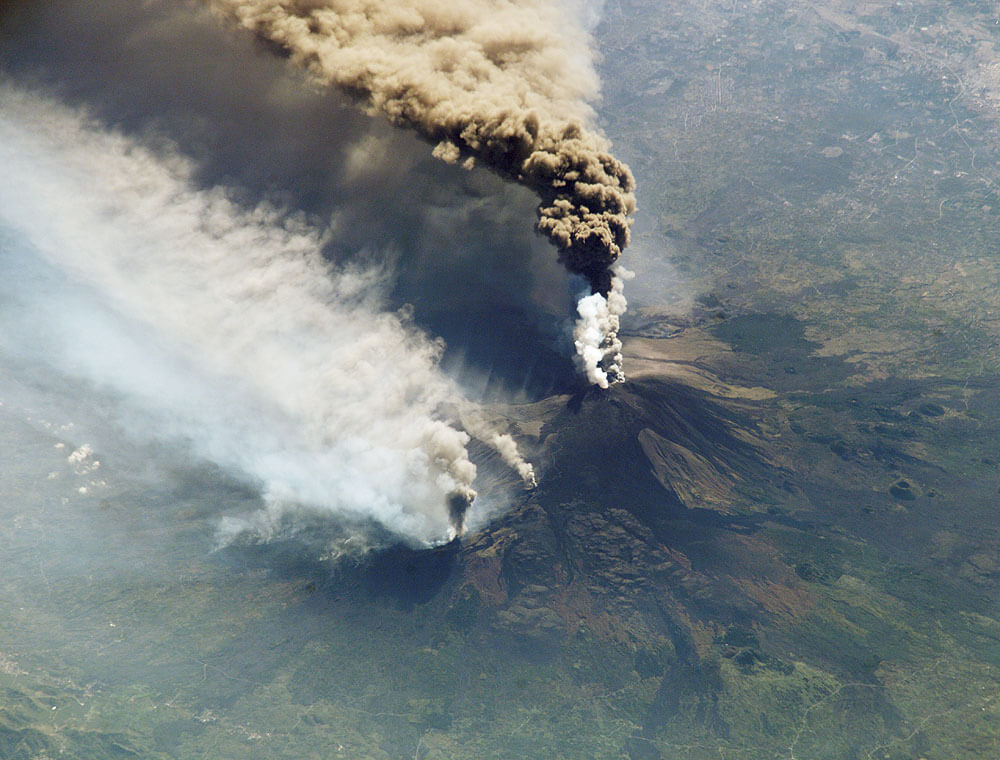 SRM replicates the effect of volcanic eruptions, which reflect radiation away from the world's surface
The case for governance
Because of the geopolitical risks of SRM, Pasztor has been involved in setting up the Carnegie Climate Geoengineering Governance Initiative (C2G2), which calls for an international agreement to put deployment of SRM on hold until more experiments have taken place.
“Our number one priority is to work in a way to push countries to agree to put on hold any deployment of solar radiation management until we better understand the costs, the risks, and the potential benefits, and, secondly, until we know better and agree on the framework we need for its governance,” said Pasztor.
To this end, Pasztor and his colleagues are travelling the world, meeting with governments, NGOs, businesses, and even religious leaders, trying to build a commitment to climate governance, and a moratorium on full-scale deployment.
C2G2 plans to build up enough support to push for a resolution against SRM deployment by 2022, a year after the IPCC’s next major report. They hope that by targeting and convincing influential figures in world politics, others will quickly get on board.
“This is a problem that requires intergovernmental solutions, and the governments have not been thinking about it"
“This is a problem that requires intergovernmental solutions, and the governments have not been thinking about it,” said Pasztor. “Our C2G2 Initiative is only one year old, so we’re just beginning to create a network. We don’t have a specific package that we want governments to agree, other than putting on hold deployment of solar geoengineering until we know better the risks and potential benefits, and we agree on the necessary governance frameworks.”
Whatever the outcome, it is becoming increasingly likely that geoengineering of some sort will be used in the fight against climate change. Since an increase in temperatures above 2 degrees looks increasingly unavoidable, a mix of ending the burning of fossil fuels, geoengineering, and adapting to inevitable change will be the reality.
“This is the challenge: the concept of geoengineering our climate – it’s terrifying,” said Pasztor. “It would have tremendous impact, but if we’d done what we should have done 20 to 30 years ago, we wouldn’t be here. But we are here. We don’t have good options. We only have risk options here and other risk options there. It's this risk versus that risk."
e(Picture credit: Flickr/NASA's Marshall Space Flight Center's photostream/DVIDSHUB/NASA's Goddard Space Flight Center's Photostream)
Anoush Darabi
anoush.darabi@apolitical.co
Make sure to share your own thoughts with the author by leaving a comment below

Log in or sign up to continue the conversation